What "Job-Ready" Really Means for QA Career Switchers (The Honest Truth)
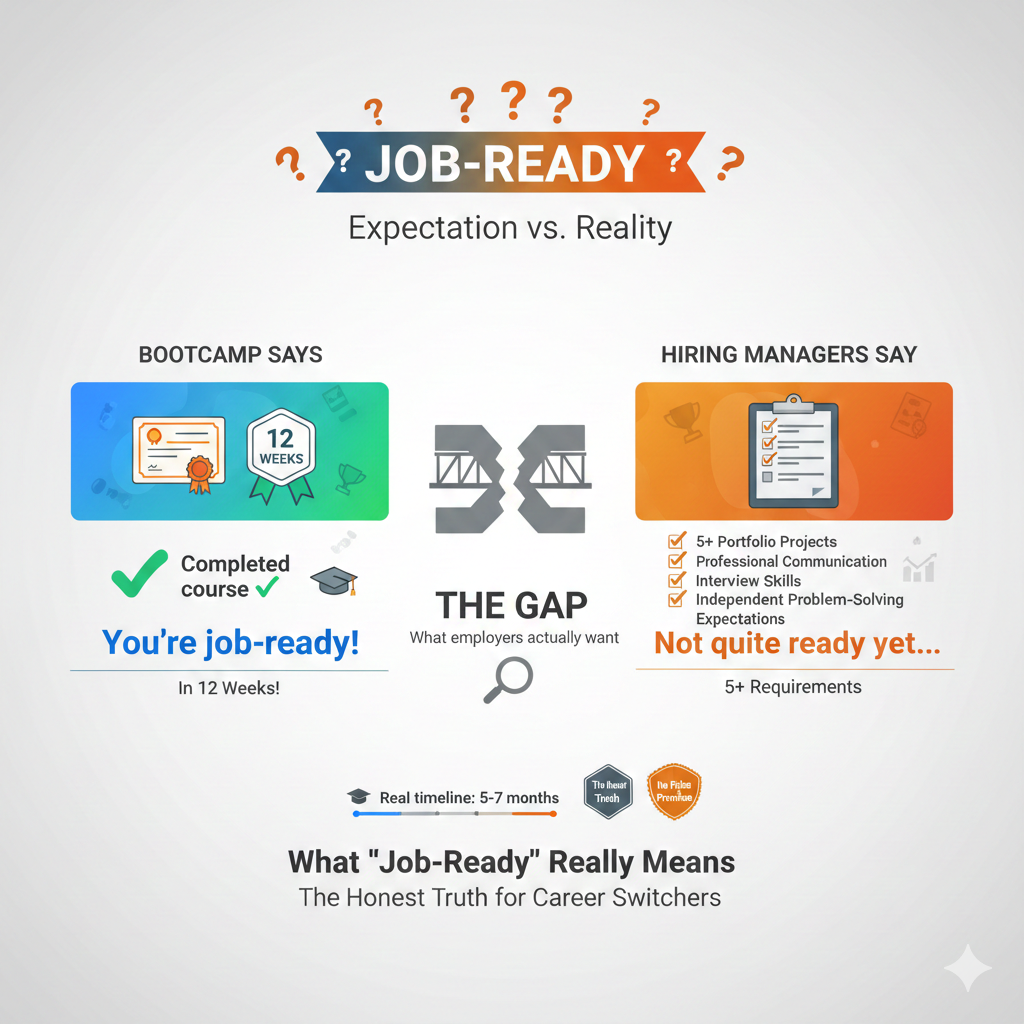
You've seen the ads. "Become job-ready in 12 weeks!" "Land your dream QA job in 3 months!" "100% job placement guarantee!"
Here's what they don't tell you: "Job-ready" doesn't mean what you think it means.
When a bootcamp says you're "job-ready," they mean you know the basics. When a hiring manager says someone is "job-ready," they mean something completely different.
This gap—between what programs promise and what employers actually want—is why 60% of bootcamp graduates struggle to land their first tech job within 6 months.
Let's be honest about what "job-ready" actually means in 2026, what it takes to get there, and how to tell if you're truly ready to compete for QA roles.
The Harsh Reality: What Bootcamps Call "Job-Ready"
Most QA courses and bootcamps define "job-ready" as:
✅ Completed all course modules
✅ Passed final exam or project
✅ Can explain testing concepts in theory
✅ Built 1-2 sample projects following tutorials
Their logic: "You know manual testing basics and touched Selenium. You're ready!"
The problem: This gets you a certificate. It doesn't get you a job.
Here's what actually happens:
Week 1 after bootcamp:
You apply to 20 junior QA jobs. You're confident—you just spent 12 weeks learning.
Week 4:
2 responses. 18 rejections. Both responses are generic: "We've decided to move forward with other candidates."
Week 8:
You've applied to 60 jobs. 5 phone screens. Zero second interviews. Feedback (when you get it): "You have the basics, but we need someone who can contribute immediately."
Week 12:
Panic sets in. You spent €3,000-7,000 on a bootcamp. You were promised "job-ready." But you're not landing interviews, let alone offers.
This isn't your fault. You were sold a distorted definition of "job-ready."
What Hiring Managers Actually Mean By "Job-Ready"
We surveyed 25 hiring managers and QA leads at European companies in January 2026. Here's what they look for in junior QA candidates:
1. Can Start Contributing Within 2 Weeks
What they said:
"Job-ready means I can hand you a user story on Day 3, and by Day 10, you're writing test cases without constant supervision."
What this requires:
- Understanding requirements and asking clarifying questions
- Writing clear, maintainable test cases independently
- Logging bugs in JIRA without needing formatting help
- Following existing team processes without reinventing the wheel
Bootcamp graduate reality:
Most can write test cases—if you sit with them for an hour explaining the requirements. They need 4-6 weeks of heavy hand-holding.
Actual job-ready candidate:
Has written 20+ test cases across 3-5 different features in portfolio projects. Knows how to ask "What should happen if...?" questions. Can work independently for 80% of tasks.
2. Portfolio That Proves You Can Do the Work
What they said:
"If someone shows me a GitHub with 5 real testing projects—actual bugs found, test cases documented, automation scripts that run—that matters more than any certificate."
What this requires:
- 4-6 projects testing different types of applications (web, API, mobile-friendly)
- Clear documentation (READMEs explaining what you tested and why)
- Real bugs found and documented professionally
- At least 1-2 automation projects (even basic ones)
Bootcamp graduate reality:
1-2 tutorial-based projects everyone in their cohort also built. Minimal documentation. No unique bugs found (everyone found the same ones in the practice app).
Actual job-ready candidate:
GitHub portfolio with 5+ projects showing progression: early projects are simple, later projects show complexity. Each project has professional README, clear test strategy, actual evidence of independent thinking.
3. Can Communicate Like a Professional
What they said:
"I need someone who can write a bug report that developers don't ignore. Who can explain testing coverage to a product manager. Who responds to Slack messages clearly."
What this requires:
- Bug reports with: steps to reproduce, expected vs. actual results, environment details, screenshots
- Can explain technical concepts to non-technical stakeholders
- Written communication is clear and professional (not "the thing didn't work lol")
- Can articulate trade-offs: "We can test X thoroughly or Y quickly—what's the priority?"
Bootcamp graduate reality:
Bug reports are technically correct but robotic (following a template without context). Struggle to explain "why" behind their testing decisions. Communication is either too technical or too casual.
Actual job-ready candidate:
Bug reports read like they're helping the developer, not blaming them. Can explain testing strategy in a 2-minute standup. Writes emails/messages hiring managers would show as examples to their team.
4. Self-Directed Learning Mindset
What they said:
"I can't train someone on every tool we use. I need someone who can learn TestRail or Cypress on their own in 2-3 days by reading docs and experimenting."
What this requires:
- Proven track record of learning tools independently (evidence: your portfolio)
- Comfortable reading documentation (not just watching videos)
- Can Google error messages and troubleshoot before asking for help
- Learns from feedback without needing the same explanation twice
Bootcamp graduate reality:
Comfortable with tools they were taught (JIRA, Selenium basics). Panic when company uses TestRail, Playwright, or custom tools. Wait for someone to "teach them" instead of figuring it out.
Actual job-ready candidate:
Portfolio shows they learned 5-8 different tools across projects. README explicitly says "I learned X by reading Y documentation." In interviews, they talk about how they debugged problems independently.
5. Realistic Expectations About the Role
What they said:
"I need someone who understands QA isn't glamorous. You'll run regression tests. You'll retest the same bug 3 times. You'll test boring admin panels, not just sexy user features."
What this requires:
- Understanding that 60% of junior QA work is repetitive (regression, smoke tests, retesting)
- Appreciation for detail work (testing edge cases, validating data)
- Long-term view: "This role builds skills for my 2-3 year career goal"
- No expectation of immediate automation or leadership
Bootcamp graduate reality:
Excited about automation, talks about "AI in testing" in interviews. Seems disinterested when asked about manual regression testing. Gives off "this is a stepping stone" energy.
Actual job-ready candidate:
Talks about finding satisfaction in thorough testing. Asks about the team's testing process, what types of bugs are most common, how they prioritize test coverage. Shows genuine interest in being a good junior tester first.
The Job-Ready Reality Check: A Self-Assessment
Answer these honestly:
Technical Readiness
✅ I can write 20 test cases for a login feature in under 2 hours without Googling "how to write test cases"
✅ I've found and documented at least 15 real bugs (not tutorial bugs) in real applications
✅ I can explain boundary value analysis, equivalence partitioning, and state transition testing in simple terms
✅ I have 3-5 projects on GitHub with professional documentation
✅ I can write 10 basic Selenium or Postman tests without following a tutorial step-by-step
✅ I understand the difference between severity and priority and can explain it with real examples
If you checked 4-6: You're technically ready.
If you checked 2-3: You're close but need more practice.
If you checked 0-1: You're not technically job-ready yet.
Professional Readiness
✅ My resume gets callbacks from at least 20-30% of jobs I apply to
✅ I can explain my career switch in 60 seconds without apologizing
✅ I've practiced answering 20+ common QA interview questions out loud
✅ I can talk about my projects for 10 minutes without notes
✅ My LinkedIn profile is complete with professional photo, summary, and projects
✅ I've had at least 1 mock interview where someone critiqued my answers
If you checked 5-6: You're professionally ready.
If you checked 3-4: You need interview prep.
If you checked 0-2: Employers will sense uncertainty in interviews.
Mindset Readiness
✅ I understand my first QA job might pay €18-26k in Poland / €35-42k in Western Europe
✅ I'm prepared to apply to 50-100 jobs before landing an offer
✅ I can handle 80% rejection rate without giving up
✅ I'm ready to start with manual testing even though I learned automation
✅ I accept that the first 6 months will involve repetitive work
✅ I have 3-6 months of financial runway while job searching
If you checked 5-6: You're mentally ready.
If you checked 3-4: Adjust your expectations now to avoid disappointment.
If you checked 0-2: You're likely to quit after 20 rejections.
What "Job-Ready" Really Looks Like: A Real Example
Meet Kasia (real mentee, name changed). Here's her progression:
Month 0 (Before Learning QA):
- Background: 4 years retail management
- Tech experience: Zero
- Goal: "Get a tech job"
Month 4 (After Generic Bootcamp):
- Completed 12-week bootcamp (€3,500)
- Certificate: "QA Fundamentals"
- Portfolio: 2 projects (both from bootcamp curriculum)
- Applications: 30 sent
- Result: 1 callback, 0 offers
What was missing?
Technical skills were there (she could explain testing concepts). But her portfolio looked identical to 50 other bootcamp grads. Her resume didn't tell a compelling story. In interviews, she couldn't explain why QA—just that she "wanted to get into tech."
Months 5-8 (With Focused Mentoring):
What changed:
- Built 3 new portfolio projects testing real public sites (not practice apps)
- Documented bugs she found on GitHub with professional bug reports
- Rewrote her resume to position her retail management as "systematic problem-solving"
- Practiced 30 interview questions until answers felt natural
- Did 4 mock interviews with feedback
Month 9 (Job Search Round 2):
- Applications: 45 sent
- Callbacks: 14 (31% rate)
- First-round interviews: 8
- Second-round interviews: 4
- Job offers: 2
What made the difference?
When hiring managers looked at Kasia's GitHub, they saw:
- "E-commerce Checkout Testing (25 test cases, 8 bugs found)"
- "Login Security Bug Analysis (SQL injection vulnerability documented)"
- "API Testing with Postman (15 REST endpoint tests)"
Her resume no longer said "Recent bootcamp graduate seeking QA role." It said "QA Tester with hands-on experience in manual and automated testing through portfolio projects."
In interviews, when asked "Why QA?", she didn't say "I want to get into tech." She said:
"In retail management, I was constantly troubleshooting—why are sales down? Why is this process breaking? I realized I enjoyed the investigative work more than the management. QA is professional troubleshooting, and that's exactly the work I want to do."
That's job-ready. Not because she completed a course. Because she could prove she could do the work.
The 5-Month Path to Actually Being Job-Ready
Here's what it realistically takes to go from zero to job-ready:
Months 1-3: Build Foundation + Portfolio
Technical work (80-100 hours):
- Manual testing fundamentals: test design, bug reporting, SDLC/STLC
- Build 4-5 projects testing real applications
- Document everything professionally on GitHub
- Optional: ISTQB certification (adds credibility)
Professional work (20-30 hours):
- LinkedIn profile optimization
- Resume draft #1
- Start following QA communities (Reddit, LinkedIn groups)
Outcome: You can do the work, but you're not interview-ready yet.
Month 4: Add Automation + Advanced Skills
Technical work (60-80 hours):
- Learn basic Selenium or Postman
- Build 1-2 automation projects
- Practice API testing
- Understand CI/CD concepts (even if you haven't used them)
Professional work (20 hours):
- Resume draft #2 (now includes automation skills)
- Draft answers to 20 common interview questions
- Start applying to 5-10 jobs per week (practice applications)
Outcome: Your portfolio is now competitive. You're starting to get callbacks.
Month 5: Interview Prep + Active Job Search
Interview preparation (40-50 hours):
- Mock interviews (at least 2-3)
- Practice explaining your projects out loud
- Refine your "career switch story"
- Research companies you're applying to
Job search (30-40 hours):
- Applying to 15-20 jobs per week
- Following up on applications
- Networking (reaching out to QA professionals)
- Iterating on resume based on feedback
Outcome: You land 3-5 interviews. You get at least 1-2 offers.
Why Most Programs Stop at Month 3
Here's the uncomfortable truth about bootcamps and courses:
They measure success by completion, not by job placement.
A bootcamp can say "95% of students complete the program!" That's true. What they don't say: Only 40% get jobs within 6 months.
Why they stop at Month 3:
- Job search support is expensive (requires human time)
- Mock interviews don't scale (can't automate them)
- Accountability is hard (students drop off when job search gets tough)
The result: You're "course-ready" (can pass their exam) but not "job-ready" (can pass hiring manager scrutiny).
What TestTactix Does Differently
We don't promise "job-ready in 12 weeks" because that's not realistic for most career switchers.
Our definition of job-ready:
- You have 4-6 portfolio projects hiring managers want to see
- Your resume gets 25-35% callback rate (vs. 5-10% average)
- You've done at least 3 mock interviews and fixed weak answers
- You can confidently explain your career switch
- You're applying to jobs systematically, not randomly
How we get you there:
Months 1-3: Technical foundation
You build portfolio projects with weekly feedback. We don't teach you theory from scratch (you can get that free online). We guide you on what projects matter and how to present them.
Month 4: Automation + Skill Depth
Basic Selenium/Postman work. Code reviews so your scripts are professional, not just "working." This is where bootcamp grads plateau—we push you further.
Month 5: Job Search Intensive
This is what most programs skip. Weekly job search check-ins. Mock interviews (recorded, so you see yourself). Resume iterations. Application strategy (which jobs to target, which to skip). Emotional support when you get your 30th rejection.
We don't stop when the curriculum ends. We stop when you get hired.
That's 5 months. Not 12 weeks. Because job-ready takes time.
The Honest Timeline: When Are You Really Ready?
After 3 months of focused learning:
You're technically competent. You can do QA work under supervision. You're not job-ready yet.
After 4 months:
You have a competitive portfolio. You're ready to start applying. You'll get some callbacks but might struggle in interviews.
After 5 months:
You're truly job-ready. Portfolio, resume, interview skills, and realistic expectations all align. You start getting offers.
After 6+ months:
If you're still not hired, the issue isn't skills—it's strategy. You're applying to the wrong roles, or your interview answers need work, or your resume isn't optimized.
Key point: Everyone's timeline is slightly different. Some land jobs in Month 4. Some need until Month 6-7. The average for career switchers with no tech background is 5-7 months of focused effort.
Anyone who promises faster than that is either:
- Lying
- Cherry-picking their best success stories
- Defining "job-ready" differently than employers do
The Red Flags: Spotting Fake "Job-Ready" Programs
Red Flag #1: "Job-ready in 8-12 weeks"
For career switchers with zero tech background? Not realistic unless you're studying 40+ hours per week.
Red Flag #2: "100% job placement guarantee"
Read the fine print. Usually means "We'll help you apply to jobs" not "We guarantee you'll get hired."
Red Flag #3: No portfolio requirement
If the program doesn't make you build 4-6 real projects, you won't have proof of your skills.
Red Flag #4: No mock interviews
Knowing QA concepts ≠ explaining them clearly in an interview. If they don't practice this with you, you'll bomb interviews.
Red Flag #5: They stop supporting you after the course ends
The hardest part is the job search. Programs that disappear after Month 3 leave you stranded.
The Realistic Expectations You Need
If you're switching to QA with zero tech background, here's what to expect:
Time investment: 200-300 hours of focused learning + 80-100 hours of job search
Timeline: 5-7 months from starting to first offer
Application volume: 50-150 applications (yes, really)
Interview-to-offer ratio: 8-12 interviews to land 1-2 offers
Starting salary (Europe): €18-26k Poland, €35-45k Western Europe
First job role: Likely junior QA tester doing 70% manual, 30% automation (not the reverse)
First 6 months on the job: Learning company tools, following processes, doing repetitive regression testing
This isn't glamorous. But it's real.
And if you go in with these expectations, you won't quit after 3 months because "this is harder than I thought."
Are You Ready? The Final Test
Answer this:
"Can I confidently walk into an interview tomorrow and:
- Explain what I've tested and how
- Show 4-6 projects on my laptop
- Answer 20 common QA questions without fumbling
- Explain my career switch in a compelling way
- Discuss trade-offs in testing strategy
- Ask intelligent questions about their QA process"
If yes: You're job-ready. Start applying aggressively.
If no: You're close, but you need:
- More portfolio work
- Interview practice
- Resume refinement
- Confidence-building
When You're Ready for the Real Path to Job-Ready
We don't promise shortcuts. We promise the real work that actually gets you hired.
Our 5-month Career Switcher program:
- Months 1-3: Build portfolio projects that prove you can test
- Month 4: Add automation skills + code reviews
- Month 5: Job search intensive—mock interviews, resume optimization, application strategy
What we don't promise:
- ❌ Job guarantee
- ❌ "Ready in 12 weeks"
- ❌ 100% placement rate
What we do promise:
- ✅ You'll have a portfolio hiring managers respect
- ✅ You'll know when you're truly ready (we'll tell you honestly)
- ✅ We won't abandon you after the curriculum ends
Ready to do the real work? Apply for our Career Switcher mentoring program →
We're working with 8-10 mentees this cohort. No inflated promises. No fake timelines. Just the honest path to becoming job-ready.
Questions about what job-ready really means? Drop them in the comments below. We read and respond to every one.
About TestTactix
We help non-tech professionals transition to QA careers through personalized 1-on-1 mentoring. Our 5-month program focuses on what actually gets you hired: portfolio projects, interview skills, and realistic job search strategies—no fake promises, no job guarantees, just honest work that leads to real outcomes.