10 Transferable Skills That Make You Perfect for QA (Even With Zero Tech Experience)
You're sitting at your retail job, your finance desk, or your teaching classroom, thinking: "I want to work in tech, but I don't have a technical background. Will anyone hire me for QA?"
Here's what most career switchers don't realize: The best QA testers aren't necessarily the most technical people. They're the most observant, systematic, and communicative.
And you already have those skills. You just haven't learned to recognize them yet.
This article will show you exactly which skills from your current (non-tech) career translate directly to QA work—and how to position them so hiring managers see you as a qualified candidate, not a "career changer with no experience."
The Reality: Most QA Skills Aren't Technical
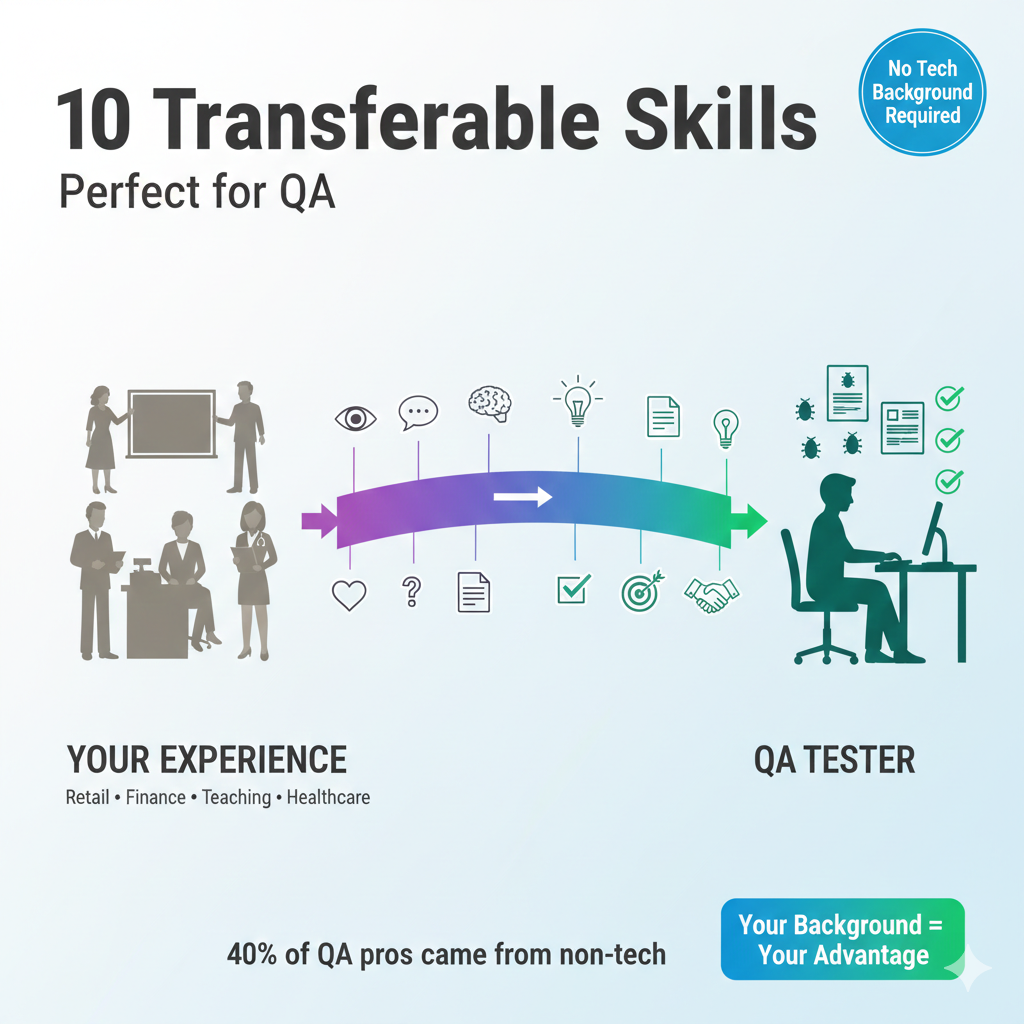
Here's a stat that surprises most career switchers: According to LinkedIn's 2026 Emerging Jobs Report, 40% of current QA professionals came from non-tech backgrounds.
Why? Because the core skills that make someone great at QA are:
- Observation: Noticing what others miss
- Critical thinking: Asking "What if...?"
- Communication: Explaining complex problems clearly
- Empathy: Understanding how users experience software
- Persistence: Not giving up when bugs are hard to reproduce
Notice what's missing from that list? Programming. Computer science degrees. Years of tech experience.
Those technical skills can be learned in 3-6 months. The human skills—observation, communication, critical thinking—take years to develop. And you already have them.
Let's identify exactly which skills you've been building without realizing it.
Skill #1: Attention to Detail
You have this if you've worked in:
- Accounting/Finance (reconciling numbers, finding discrepancies)
- Editing/Proofreading (catching typos, inconsistencies)
- Quality Control (manufacturing, food service)
- Data Entry (accuracy matters)
- Pharmacy/Healthcare (dosage errors = life-threatening)
Why QA needs it:
Software bugs hide in tiny details. A button that's 2 pixels misaligned. A form that accepts 100 characters but should accept 99. A date field that works for "01/15/2026" but breaks for "1/15/2026."
Average users don't notice. Good QA testers do.
Real example from a career switcher:
"I was a bookkeeper for 5 years. My job was finding $0.01 discrepancies in 10,000-line spreadsheets. In QA, I apply the same mindset: Where do the numbers not add up? Where are the inconsistencies? I once found a bug where an e-commerce cart calculated tax correctly for €100 but incorrectly for €100.01—a rounding error most people missed."
How to position this on your resume:
- ❌ "Detail-oriented professional"
- ✅ "Identified and resolved 200+ financial discrepancies with 99.8% accuracy over 5 years, preventing $50K in errors"
Skill #2: Analytical Thinking
You have this if you've worked in:
- Finance/Investment Analysis (breaking down complex data)
- Research (academic, market research, user research)
- Consulting (problem decomposition)
- Operations/Process Improvement (root cause analysis)
- Engineering (any type)
Why QA needs it:
QA isn't just "click all the buttons and see what breaks." It's:
- Analyzing requirements to understand what should happen
- Breaking down complex features into testable components
- Identifying edge cases and dependencies
- Performing root cause analysis when bugs occur
Real example from a career switcher:
"I was a financial analyst. My job was analyzing quarterly reports and spotting trends. In QA, I apply the same analytical mindset: When a bug occurs, I don't just report 'the login broke.' I analyze: Is it browser-specific? Does it happen with all users or just certain roles? Is it related to recent code changes? That analytical approach makes me valuable to developers—I give them context, not just bug reports."
How to position this on your resume:
- ❌ "Strong analytical skills"
- ✅ "Analyzed 500+ customer transactions monthly to identify patterns in system failures, reducing recurring issues by 30%"
Skill #3: Communication Skills (Written & Verbal)
You have this if you've worked in:
- Customer Service (explaining problems clearly)
- Teaching (breaking down complex concepts)
- Sales/Account Management (stakeholder communication)
- Project Management (coordinating across teams)
- Journalism/Writing (clear, concise communication)
Why QA needs it:
The best bug report in the world is useless if developers can't understand it. QA testers are translators between users and technical teams.
You need to:
- Write clear, reproducible bug reports
- Communicate testing status to project managers
- Explain technical issues to non-technical stakeholders
- Collaborate with developers without conflict
Real example from a career switcher:
"I was a customer service rep for 7 years. I dealt with angry customers who said things like 'Your site doesn't work!' I'd ask clarifying questions: What exactly were you trying to do? What happened instead? What browser were you using? That's exactly what QA does—gathering details, reproducing issues, and documenting clearly. Developers love working with me because my bug reports have all the information they need."
How to position this on your resume:
- ❌ "Excellent communication skills"
- ✅ "Documented 150+ customer issues with detailed reproduction steps, achieving 95% first-time resolution rate by developers"
Skill #4: Problem-Solving
You have this if you've worked in:
- IT Support/Help Desk (troubleshooting)
- Operations (solving process bottlenecks)
- Event Planning (handling unexpected issues)
- Hospitality (managing crises)
- Any role where "things went wrong and you fixed them"
Why QA needs it:
Testing isn't just executing test cases. It's:
- Figuring out why a bug only happens on Tuesdays
- Finding workarounds when test environments are broken
- Determining if a defect is in the code, the test data, or the test environment
- Deciding what to test when time is limited
Real example from a career switcher:
"I was a restaurant manager. Every shift, something went wrong: supplier didn't deliver, equipment broke, staff called in sick. I became an expert at problem-solving under pressure. In QA, I apply that same mindset: The test environment is down? I find another way to test. A developer says a bug isn't reproducible? I try different approaches until I figure out the exact conditions that trigger it."
How to position this on your resume:
- ❌ "Strong problem-solver"
- ✅ "Resolved 50+ critical operational issues monthly by systematically identifying root causes and implementing process improvements"
Skill #5: Empathy and User Perspective
You have this if you've worked in:
- Customer Service (understanding user frustration)
- UX Research (user empathy)
- Retail (seeing things from the customer's perspective)
- Healthcare (patient care perspective)
- Social Work/Counseling (human-centered thinking)
Why QA needs it:
Developers build features based on technical specs. QA testers ask: "But will users understand this? Will this make sense to someone who isn't a developer?"
The best QA testers think like users:
- "This error message says 'Error 500.' A user has no idea what that means."
- "This form has 20 fields. Users will abandon it."
- "The save button is gray. Users expect blue. They might not realize it's clickable."
Real example from a career switcher:
"I worked in retail for 6 years. I watched customers struggle with our self-checkout kiosks every single day. They'd get confused by poorly worded prompts or unclear buttons. When I test software now, I channel that experience: I think like a non-technical user. I catch usability issues that developers miss because they're too close to the code. 'This makes sense to you, but will it make sense to a 60-year-old who isn't tech-savvy?'"
How to position this on your resume:
- ❌ "Customer-focused mindset"
- ✅ "Identified 25+ usability issues through user-centered testing approach, improving customer satisfaction scores by 18%"
Skill #6: Documentation Skills
You have this if you've worked in:
- Administrative roles (creating SOPs, manuals)
- Compliance/Legal (documentation is critical)
- Project Management (keeping detailed records)
- Healthcare (medical records, charting)
- Quality Control (audit trails, documentation)
Why QA needs it:
QA work is documentation-heavy:
- Test plans
- Test cases
- Bug reports
- Test execution reports
- Requirements traceability matrices
If you can write clear, structured documentation in any format, you can do QA documentation.
Real example from a career switcher:
"I was an administrative assistant for 8 years. I created SOPs, meeting notes, training manuals. My documentation was so thorough that new employees used my guides years after I wrote them. In QA, I apply that same skill: I write test cases that anyone can execute, even if I'm not there. I document bugs so clearly that developers know exactly how to reproduce them. Documentation is my superpower."
How to position this on your resume:
- ❌ "Strong documentation skills"
- ✅ "Created and maintained 200+ SOPs with 100% compliance rate during audits, reducing onboarding time by 40%"
Skill #7: Process Adherence and Compliance
You have this if you've worked in:
- Banking/Finance (regulatory compliance)
- Healthcare (following protocols)
- Manufacturing (quality standards, ISO compliance)
- Government/Public Sector (policy adherence)
- Food Service (health codes, procedures)
Why QA needs it:
QA work requires following processes:
- Test cases must be executed exactly as written
- Regression tests must run in the same order every time
- Bug reports must follow specific templates
- Release processes must follow checklists
If you've worked in a compliance-heavy environment, you understand why processes matter and how to follow them consistently.
Real example from a career switcher:
"I worked in a hospital for 5 years. We had strict protocols for everything—medication administration, patient charts, safety procedures. You couldn't skip steps, even when you were busy. That discipline translates perfectly to QA: I follow test plans exactly. I don't skip regression tests even when we're close to release. I understand that 'good enough' isn't good enough when quality matters."
How to position this on your resume:
- ❌ "Follows processes and procedures"
- ✅ "Maintained 100% compliance with regulatory protocols across 500+ audits, ensuring zero critical violations"
Skill #8: Collaboration and Stakeholder Management
You have this if you've worked in:
- Project Management (coordinating teams)
- Account Management (managing client relationships)
- Event Planning (coordinating vendors, clients, venues)
- HR (mediating between employees and management)
- Sales (negotiating, building relationships)
Why QA needs it:
QA doesn't work in isolation. You collaborate with:
- Developers: "This is a bug" → "No, it's working as designed" → resolution
- Product Managers: "We need to ship Friday" → "But we haven't tested X, Y, Z"
- Business Stakeholders: Explaining why quality matters
- Support Teams: Understanding customer-reported issues
Real example from a career switcher:
"I was an account manager for 10 years. My job was managing client expectations, negotiating deadlines, and keeping everyone happy. In QA, I use the exact same skills: When I find a critical bug 2 days before release, I don't just say 'We can't ship.' I present options: 'Option A: Delay by 3 days and fix it. Option B: Ship with a known issue and document the workaround. Option C: Hide the feature for now.' Stakeholder management is half of QA work."
How to position this on your resume:
- ❌ "Team player with great collaboration skills"
- ✅ "Managed cross-functional relationships with 20+ stakeholders, resolving conflicts and aligning priorities to deliver 15 projects on time"
Skill #9: Curiosity and Continuous Learning
You have this if you've:
- Self-taught yourself anything (language, instrument, skill)
- Pursued certifications or training outside of work requirements
- Enjoyed figuring out how things work as a kid
- Read industry news, blogs, or books to stay current
- Asked "Why?" and "What if?" regularly
Why QA needs it:
Technology changes fast. Tools, frameworks, and best practices evolve constantly. QA testers must be:
- Willing to learn new tools (yesterday it was Selenium, today it's Playwright)
- Curious enough to explore edge cases ("What if a user does THIS?")
- Open to feedback and process improvements
Real example from a career switcher:
"I was a teacher for 12 years. Every year, new curriculum standards. New educational technology. New teaching methods. I had to continuously learn or become obsolete. In QA, I apply that same learning mindset: New automation tool released? I spend my weekend learning it. New testing technique? I experiment with it. My curiosity makes me better at finding bugs—I ask 'What if?' more than most people."
How to position this on your resume:
- ❌ "Quick learner, eager to grow"
- ✅ "Self-taught Python, Selenium, and Postman within 4 months through 200+ hours of independent study and portfolio projects"
Skill #10: Persistence and Attention to Process
You have this if you've worked in:
- Any role requiring repetitive, detail-oriented work
- Research (experiments repeated multiple times)
- Quality Control (inspecting 100s of items per day)
- Data Analysis (running tests, analyzing results)
- Customer Support (following up on unresolved issues)
Why QA needs it:
QA work can be repetitive:
- Running the same regression tests every sprint
- Retesting bug fixes 5 times because developers keep introducing new issues
- Executing 100 test cases before every release
You need persistence to stay sharp during repetitive work and not miss details.
Real example from a career switcher:
"I was a lab technician for 7 years. I ran the same tests hundreds of times. Same procedure, same steps, every single time. Precision mattered—one skipped step could invalidate results. That discipline is exactly what QA needs. When I'm running regression tests for the 50th time, I don't get sloppy. I stay focused. I catch bugs in test case 98 that others would miss because they rushed through it."
How to position this on your resume:
- ❌ "Hardworking and persistent"
- ✅ "Executed 5,000+ quality control inspections with 99.6% accuracy, identifying defects that prevented $200K in warranty claims"
How to Position Your Transferable Skills (Resume Strategy)
Now that you've identified your skills, here's how to make hiring managers see them.
Strategy 1: Reframe Your Experience
Before (Generic):
Customer Service Representative, Retail Store (2019-2025)
- Helped customers with purchases
- Resolved complaints
- Maintained store cleanliness
After (QA-Relevant):
Customer Service Representative, Retail Store (2019-2025)
- Systematically troubleshot 50+ customer issues daily, asking clarifying questions to identify root causes—directly applicable to bug reproduction and analysis
- Documented recurring product defects and escalated to management with detailed evidence, resulting in 30% reduction in returns
- Collaborated cross-functionally with inventory, sales, and management teams to resolve operational issues
See the difference? Same job, same responsibilities—but now it sounds like QA work.
Strategy 2: Use a "Transferable Skills" Section
If your previous career is very different from QA, add a section to your resume:
RELEVANT SKILLS FOR QA

Analytical Thinking: 5 years analyzing financial reports to identify data discrepancies and trends

Documentation: Created 100+ SOPs and training materials with 100% compliance during audits

Communication: Explained complex technical issues to non-technical stakeholders across 20+ departments

Problem-Solving: Resolved 200+ operational issues through systematic root cause analysis

Attention to Detail: Maintained 99.8% accuracy in data entry across 10,000+ records
This section explicitly connects your past to QA work.
Strategy 3: Craft Your Professional Summary
Your resume summary should position you as a QA professional with transferable skills—not a "former retail worker."
Bad:
"Retail worker looking to transition into a QA role. Quick learner eager to start a tech career."
Good:
"QA Tester with hands-on experience in manual testing and automation through 5 portfolio projects. Brings 7 years of proven analytical thinking, systematic problem-solving, and clear documentation from finance background. ISTQB certified. Seeking junior QA role where attention to detail and user-focused testing drive product quality."
Real Career Switcher Success Story
Background: Maria worked as a high school teacher for 10 years. Zero tech experience.
Transferable skills she identified:
- Communication (explaining complex concepts to teenagers = explaining bugs to developers)
- Patience (dealing with difficult students = persistence in reproducing bugs)
- Organization (lesson planning = test planning)
- Empathy (understanding student perspectives = thinking like users)
- Continuous learning (new curriculum every year = learning new tools)
What she did:
- Built 4 QA portfolio projects over 3 months
- Reframed her teaching experience on her resume using QA language
- In interviews, she said: "I've spent 10 years finding creative ways to break down complex problems. That's exactly what QA does—finding where things break."
Result: Landed a junior QA role at €22,000/year in Poland within 5 months of starting her career switch.
Her insight: "I thought my teaching background was irrelevant. But in every interview, hiring managers loved it. They said, 'Teachers make great testers—you're patient, detail-oriented, and you understand people.' I just had to learn to frame it that way."
The Bottom Line: You're More Qualified Than You Think
If you have:
✅ Attention to detail from any meticulous work
✅ Analytical thinking from problem-solving roles
✅ Communication skills from client-facing work
✅ Documentation experience from admin/compliance roles
✅ Empathy from customer service
✅ Process adherence from regulated industries
✅ Collaboration skills from cross-functional teams
✅ Curiosity and willingness to learn
✅ Persistence through repetitive work
✅ Problem-solving under pressure
Then you already have 90% of what you need for QA work.
The remaining 10%—learning tools like JIRA, Selenium, Postman—can be learned in 3-6 months.
Don't let "I don't have a tech background" stop you. Your non-tech background might be your biggest advantage.
When You Need Help Positioning Your Experience
You might have the skills, but positioning them correctly in resumes, interviews, and portfolios is an art.
In our Career Switcher mentoring program:
- Month 1: We identify your specific transferable skills and how to leverage them
- Month 3: CV optimization—reframing your non-tech experience using QA language
- Month 5: Interview coaching—articulating why your background makes you a strong QA candidate
You don't just learn QA skills. You learn how to sell your existing strengths to hiring managers.
Ready to turn your non-tech background into your competitive advantage? Apply for our Career Switcher mentoring program →
We're working with 8-10 mentees this cohort. Many of them come from retail, finance, teaching, healthcare—and they're all building strong QA careers.
Questions about transferable skills or career switching to QA? Drop them in the comments below. We read and respond to every one.
About TestTactix
We help non-tech professionals transition to QA careers through personalized 1-on-1 mentoring. Our 5-month program shows you how to position your transferable skills, build portfolio projects, and land your first QA role—no CS degree needed.