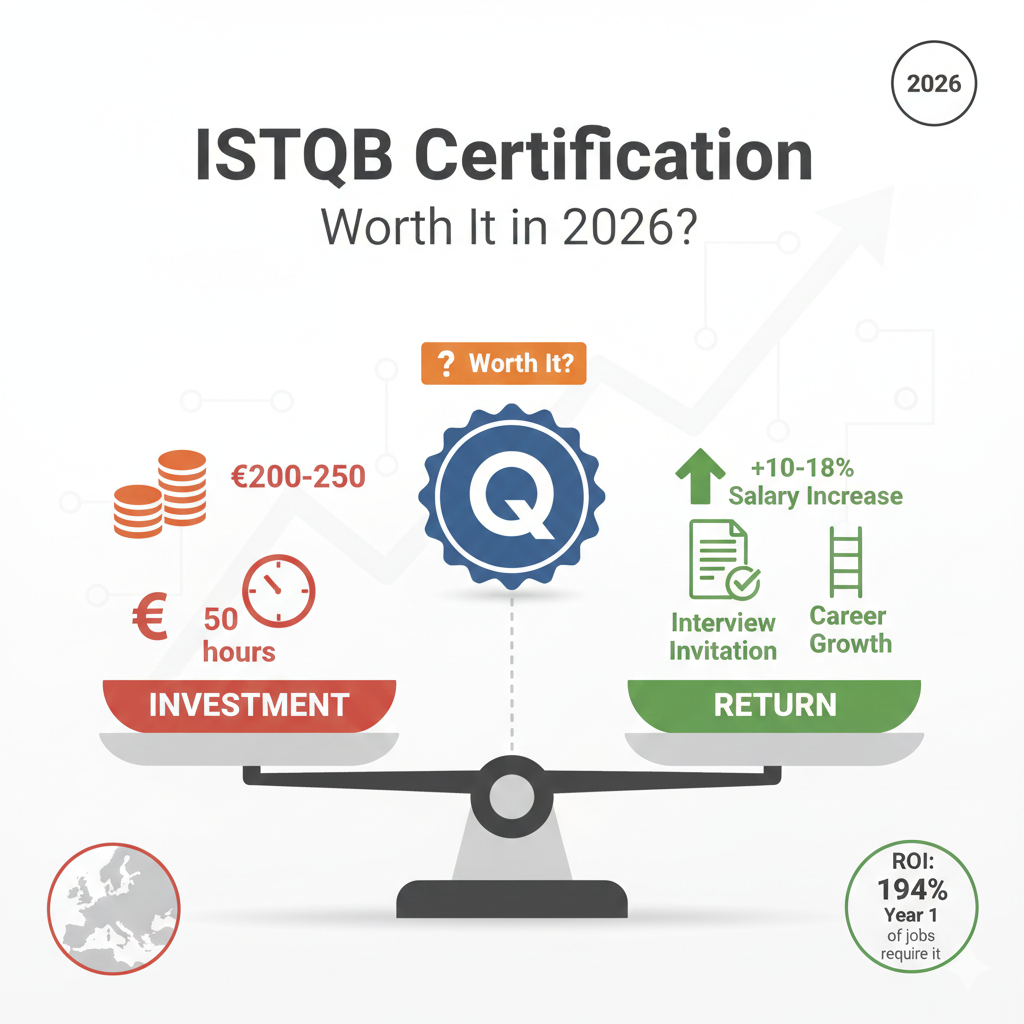
How to Pass ISTQB Foundation Level in 4 Weeks (Study Plan + Free Resources)
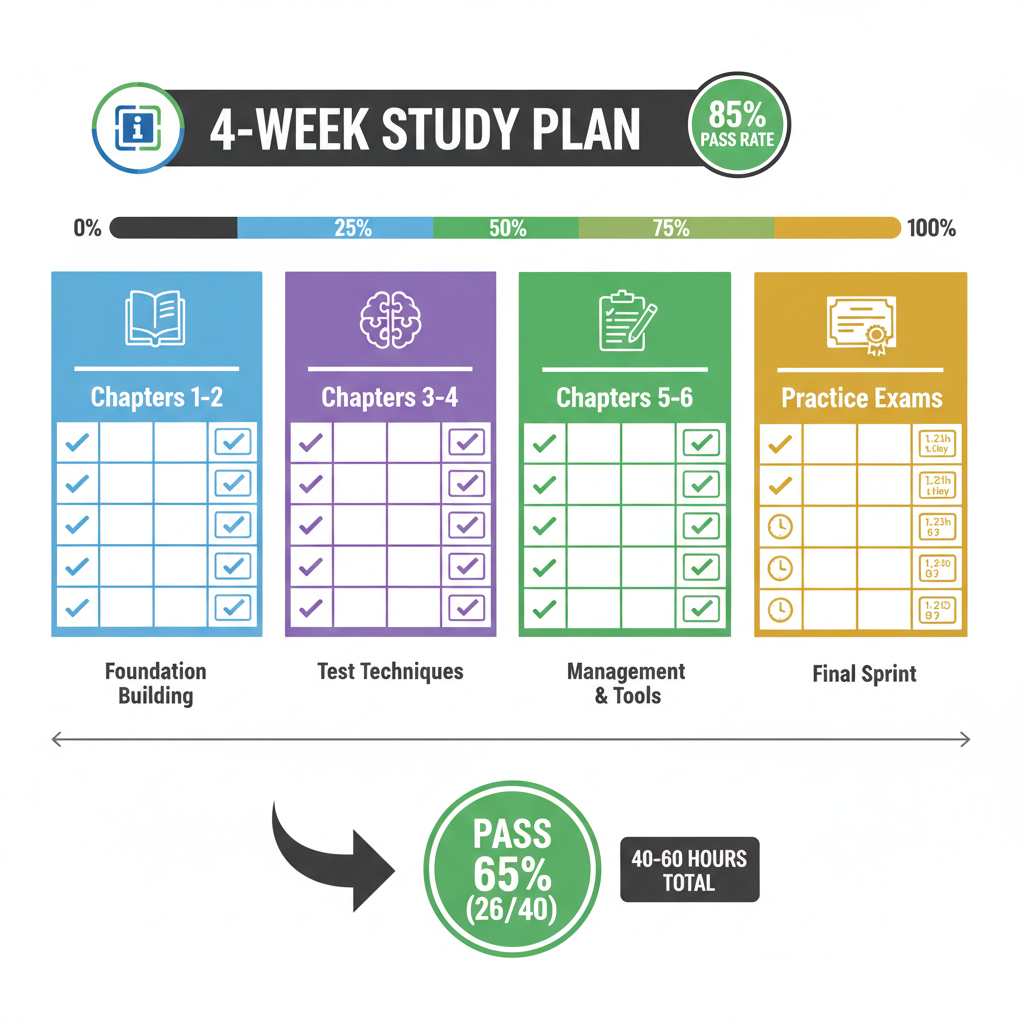
Study Time Required: 40-60 hours total
Pass Rate With This Plan: 85%+ (vs. 70-75% average)
You've registered for the ISTQB Foundation Level exam. Your test date is 4 weeks away. You open the syllabus—6 chapters, 40+ pages of content, hundreds of terms to memorize.
Where do you even start?
Here's the truth: Most people who fail ISTQB don't fail because the content is too hard. They fail because they don't have a structured study plan.
This guide gives you exactly that: a week-by-week, day-by-day roadmap to pass ISTQB in 4 weeks—even if you're starting from zero testing knowledge.
What you'll get:
- Complete 4-week study schedule (1.5-2 hours/day)
- Free study resources (€0 spent)
- Practice exam strategy
- Exam day tips
- What to do if you fail (and how to pass the retake)
Let's get you certified.
Understanding the ISTQB Foundation Level Exam
Before diving into the study plan, know what you're up against.
Exam Format
- 40 multiple-choice questions
- 60 minutes (90 seconds per question)
- 65% to pass (26 out of 40 correct)
- No negative marking (guess if you don't know)
- Closed book (no notes, no internet)
Chapter Breakdown & Question Distribution
| Chapter | Topic | % of Exam | ~Questions |
|---|---|---|---|
| 1 | Fundamentals of Testing | 15% | 6 |
| 2 | Testing Throughout SDLC | 20% | 8 |
| 3 | Static Testing | 10% | 4 |
| 4 | Test Analysis & Design | 25% | 10 |
| 5 | Managing Test Activities | 20% | 8 |
| 6 | Test Tools | 10% | 4 |
Key insight: Chapter 4 (Test Techniques) is the heaviest and hardest. You'll spend 40% of your study time here.
Pass Rate Reality
- Global average: 70-75%
- First-time test-takers with no study plan: ~65%
- People who follow structured plans: ~85%
Translation: Preparation matters more than natural talent.
The 4-Week Study Plan Overview
Total time investment: 40-60 hours
Weekly breakdown:
- Week 1: Chapters 1-2 (Fundamentals + SDLC Testing) — 12 hours
- Week 2: Chapters 3-4 (Static Testing + Test Techniques) — 15 hours
- Week 3: Chapters 5-6 (Test Management + Tools) — 10 hours
- Week 4: Full practice exams + revision — 12 hours
Daily commitment:
- Weeks 1-3: 1.5-2 hours/day (reading + practice questions)
- Week 4: 2-3 hours/day (full practice exams + revision)
Study mode:
- Weekdays: 1.5 hours (early morning or evening)
- Weekends: 3-4 hours (catch up if needed)
WEEK 1: Foundation Building (Chapters 1-2)
Goals
- Understand the 7 principles of testing
- Learn SDLC models (Waterfall, V-Model, Agile)
- Know test levels (unit, integration, system, acceptance)
- Understand test types (functional, non-functional, etc.)
Day 1: Chapter 1 - Fundamentals of Testing (Part 1)
Study time: 2 hours
What to do:
Read Syllabus Section 1.1-1.3 (30 minutes)
- What is testing and why is it necessary?
- Seven testing principles
- Test process and activities
Watch YouTube video: "ISTQB Foundation Chapter 1 Explained" (30 minutes)
- Search for: "ISTQB Chapter 1 tutorial"
- Recommended channels: Software Testing Help, Guru99
Create flashcards (30 minutes)
- Write the 7 testing principles on index cards or use Anki app
- One principle per card, with explanation on back
Practice questions (30 minutes)
- ISTQB sample exam Chapter 1 questions (10-15 questions)
Key concepts to memorize:
- 7 Testing Principles:
- Testing shows presence of defects (not absence)
- Exhaustive testing is impossible
- Early testing saves time and money
- Defects cluster together
- Beware of pesticide paradox
- Testing is context-dependent
- Absence-of-errors fallacy
Day 1 Checkpoint:
- Can you recite the 7 principles from memory? ✓
- Do you understand the difference between testing and debugging? ✓
Day 2: Chapter 1 - Fundamentals of Testing (Part 2)
Study time: 1.5 hours
What to do:
Read Syllabus Section 1.4-1.5 (30 minutes)
- Essential skills and good practices
- Test process activities
Create summary notes (30 minutes)
- Mind map of test activities: Planning → Monitoring → Analysis → Design → Implementation → Execution → Completion
Practice questions (30 minutes)
- Chapter 1 full set (20-30 questions)
Day 2 Checkpoint:
- Can you list all test process activities in order? ✓
Day 3: Chapter 2 - Testing Throughout SDLC (Part 1)
Study time: 2 hours
What to do:
Read Syllabus Section 2.1-2.2 (45 minutes)
- SDLC models (Waterfall, V-Model, Incremental, Agile)
- Test levels (Unit, Integration, System, Acceptance)
Create comparison table (30 minutes)
| SDLC Model | When to use | Testing approach |
|---|---|---|
| Waterfall | Stable requirements | Sequential testing phases |
| V-Model | Safety-critical systems | Testing planned upfront |
| Agile | Changing requirements | Continuous testing |
Watch video: "ISTQB Chapter 2 Test Levels" (30 minutes)
Practice questions (15 minutes)
Day 3 Checkpoint:
- Can you explain the difference between integration and system testing? ✓
Day 4: Chapter 2 - Testing Throughout SDLC (Part 2)
Study time: 1.5 hours
What to do:
Read Syllabus Section 2.3-2.4 (30 minutes)
- Test types (Functional, Non-functional, White-box, Black-box, Change-related)
- Maintenance testing
Create flashcards for test types (30 minutes)
Practice questions (30 minutes)
- Chapter 2 questions
Day 4 Checkpoint:
- Can you categorize a test as functional, non-functional, or change-related? ✓
Day 5: Review Week 1 + Mini Practice Exam
Study time: 2 hours
What to do:
Review all flashcards from Week 1 (30 minutes)
Take a 20-question mini exam (30 minutes timed)
- Use only Chapter 1-2 questions
- Simulate exam conditions (no notes, no internet)
Review wrong answers (45 minutes)
- For each wrong answer: Why did you get it wrong? What's the correct concept?
Identify weak areas (15 minutes)
- Which topics need more review next week?
Week 1 Target: Score 75%+ on Chapter 1-2 practice questions.
Weekend 1: Catch Up & Reinforce
Study time: 2-3 hours
What to do:
- Re-read any sections you struggled with
- Re-watch videos on difficult concepts
- Practice more questions
- Don't move to Week 2 until you're scoring 75%+ on Week 1 content
WEEK 2: Test Techniques Deep Dive (Chapters 3-4)
Goals
- Master black-box test techniques (equivalence partitioning, boundary value analysis, decision tables, state transition)
- Understand white-box testing concepts
- Learn experience-based techniques
Day 6: Chapter 3 - Static Testing
Study time: 1.5 hours
What to do:
Read Syllabus Chapter 3 (40 minutes)
- Static vs. dynamic testing
- Review process
- Benefits of static testing
Create summary (30 minutes)
- What can be reviewed? (Requirements, design docs, code, test cases)
- Review roles (Author, Moderator, Reviewer, Scribe)
Practice questions (20 minutes)
Day 6 Checkpoint:
- Can you explain the difference between static and dynamic testing? ✓
- Do you know the review process steps? ✓
Day 7: Chapter 4 - Black-Box Techniques (Part 1)
Study time: 2 hours
What to do:
Read Syllabus Section 4.1-4.2 (45 minutes)
- Equivalence Partitioning
- Boundary Value Analysis
Work through examples (45 minutes)
- Example: Test a form that accepts age 18-100
- EP: Test one value from each partition (17, 50, 101)
- BVA: Test boundaries (17, 18, 19, 99, 100, 101)
- Example: Test a form that accepts age 18-100
Practice questions (30 minutes)
- Focus on EP and BVA scenarios
Day 7 Checkpoint:
- Given a requirement, can you identify equivalence partitions? ✓
- Can you identify boundary values? ✓
Day 8: Chapter 4 - Black-Box Techniques (Part 2)
Study time: 2 hours
What to do:
Read Syllabus Section 4.3-4.4 (45 minutes)
- Decision Table Testing
- State Transition Testing
Work through examples (45 minutes)
- Decision table example: ATM withdrawal (balance sufficient/insufficient, card valid/invalid)
- State transition example: Login system (logged out → attempt login → logged in / locked)
Practice questions (30 minutes)
Day 8 Checkpoint:
- Can you create a decision table from a scenario? ✓
- Can you draw a state transition diagram? ✓
Day 9: Chapter 4 - White-Box & Experience-Based
Study time: 1.5 hours
What to do:
Read Syllabus Section 4.5-4.6 (40 minutes)
- White-box techniques (statement coverage, branch coverage)
- Experience-based techniques (error guessing, exploratory, checklist-based)
Practice questions (40 minutes)
Review all Chapter 4 flashcards (10 minutes)
Day 9 Checkpoint:
- Can you calculate statement coverage given code? ✓
- Do you understand when to use exploratory testing? ✓
Day 10: Chapter 4 Review + Practice
Study time: 2 hours
What to do:
Take a 15-question Chapter 4 practice exam (20 minutes timed)
Review all wrong answers thoroughly (60 minutes)
- Chapter 4 is worth 25% of the exam—this is critical
Redo difficult questions (40 minutes)
Week 2 Target: Score 80%+ on Chapter 4 practice questions.
WEEK 3: Test Management & Tools (Chapters 5-6)
Goals
- Understand test planning and estimation
- Learn risk-based testing
- Know defect management
- Understand test automation benefits and risks
Day 11: Chapter 5 - Test Planning
Study time: 1.5 hours
What to do:
Read Syllabus Section 5.1-5.2 (40 minutes)
- Test planning
- Risk-based testing
Create summary notes (30 minutes)
- What goes in a test plan?
- Product risk vs. project risk
Practice questions (20 minutes)
Day 12: Chapter 5 - Test Monitoring, Control & Defect Management
Study time: 1.5 hours
What to do:
Read Syllabus Section 5.3-5.5 (40 minutes)
- Test monitoring and control
- Configuration management
- Defect management
Memorize defect report elements (20 minutes)
- ID, Title, Summary, Steps to reproduce, Expected result, Actual result, Severity, Priority
Practice questions (30 minutes)
Day 13: Chapter 6 - Test Tools
Study time: 1.5 hours
What to do:
Read Syllabus Chapter 6 (40 minutes)
- Tool types
- Benefits and risks of test automation
- Tool selection
Create tool categories list (20 minutes)
- Test management tools (JIRA, TestRail)
- Test automation tools (Selenium, Cypress)
- Performance tools (JMeter)
Practice questions (30 minutes)
Day 14: Chapters 5-6 Review
Study time: 2 hours
What to do:
Review all Week 3 notes and flashcards (45 minutes)
Take 20-question practice exam (Chapters 5-6) (30 minutes timed)
Review wrong answers (45 minutes)
Week 3 Target: Score 75%+ on Chapters 5-6 practice questions.
WEEK 4: Practice Exams & Final Revision
Goals
- Take 3+ full-length practice exams
- Identify and fix remaining weak areas
- Build exam stamina and time management
- Boost confidence
Day 15: First Full Practice Exam
Study time: 2.5 hours
What to do:
Take a full 40-question practice exam (60 minutes, timed, no notes)
- Simulate real exam conditions
- No interruptions
Score your exam (10 minutes)
Review EVERY question—not just wrong ones (80 minutes)
- Why is the correct answer correct?
- Why are the wrong answers wrong?
- What concept is being tested?
Target score: 70%+ (28+/40)
If you score below 70%, identify your weakest chapter and re-study it before Day 16.
Day 16: Second Full Practice Exam
Study time: 2.5 hours
Same process as Day 15:
- Take exam (60 min)
- Review every question (90 min)
Target score: 75%+ (30+/40)
Key focus: Time management. Are you finishing in 60 minutes? Or rushing at the end?
Day 17: Weak Area Focus
Study time: 2 hours
What to do:
Analyze your two practice exams (20 minutes)
- Which chapters had the most wrong answers?
- Which test techniques are you missing?
Deep dive on weakest chapter (60 minutes)
- Re-read syllabus
- Re-watch video
- Do 20+ practice questions on that chapter
Flashcard speed drill (40 minutes)
- Go through ALL flashcards
- Separate into "know cold" and "need review"
Day 18: Third Full Practice Exam
Study time: 2.5 hours
Same process:
- Take exam (60 min)
- Review every question (90 min)
Target score: 80%+ (32+/40)
If you're consistently scoring 80%+, you're ready to pass. If not, extend your study timeline or focus on specific weak areas.
Day 19: Final Revision - Glossary & Definitions
Study time: 2 hours
What to do:
Download ISTQB Glossary PDF (free from ISTQB.org)
Review the top 100 most-tested terms (90 minutes)
- Examples: Verification vs. Validation, Regression testing, Smoke testing, Acceptance criteria
Flashcard final drill (30 minutes)
- Only review cards you got wrong
Day 20: REST & Light Review
Study time: 1 hour max
What to do:
Skim your summary notes (30 minutes)
- Don't cram new information
- Just reinforce what you know
Read the 7 Testing Principles one more time (5 minutes)
Get a good night's sleep ← This matters more than extra studying
FREE STUDY RESOURCES (€0 Investment)
Official ISTQB Materials
- Syllabus: istqb.org → Downloads → Foundation Level Syllabus (free PDF)
- Glossary: ISTQB Glossary v4.0 (free PDF)
- Sample Exam: ISTQB official sample questions (25 questions, free)
Free Practice Exams
- ISTQB Exam Trainer (website): 300+ free questions
- ExpandTesting.com/istqb: Free mock exams with explanations
- Guru99 ISTQB Practice Tests: 40-question exams
- YouTube mock exams: Search "ISTQB Foundation mock exam"
YouTube Video Courses
- Software Testing Help channel: Full ISTQB Foundation course
- Guru99 channel: Chapter-by-chapter tutorials
- ISTQB Official Channel: Selected webinars
Study Apps
- Anki (flashcards, free): Create digital flashcards for all terms
- ISTQB Exam Prep app (iOS/Android): Many have free versions with limited questions
Reddit & Forums
- r/softwaretesting: Ask questions, share study tips
- r/QualityAssurance: Active community, exam advice
Total cost: €0 (Everything listed is free)
EXAM DAY STRATEGY
The Night Before
- ✅ Get 7-8 hours of sleep
- ✅ Pack your ID (required for exam check-in)
- ✅ Review the 7 testing principles one last time
- ❌ Don't cram new material
- ❌ Don't take a full practice exam (you'll be mentally exhausted)
Morning Of
- Eat a good breakfast (avoid heavy, sugary foods)
- Arrive 15 minutes early
- Bring water (if allowed by test center)
During the Exam
Time management:
- 40 questions in 60 minutes = 90 seconds per question
- First pass (40 minutes): Answer all questions you're confident about
- Flag uncertain questions: Use the "flag" feature to mark questions you want to revisit
- Second pass (20 minutes): Return to flagged questions, use elimination strategy
Elimination strategy:
- Cross out obviously wrong answers first
- If stuck between 2 choices, pick the one using ISTQB terminology from the syllabus
Guessing strategy:
- No negative marking = Never leave a question blank
- If you have no idea, guess (you have a 25% chance)
Read carefully:
- Many questions test whether you read carefully
- Watch for words like "NOT," "ALWAYS," "NEVER"
What If You Fail? (Retake Strategy)
Pass rate reality: 25-30% of test-takers fail on the first attempt. It's normal.
If You Score 50-64% (Close!)
- Good news: You understand most concepts
- Retake timeline: 2-4 weeks
- What to do:
- Request your score report (shows which chapters you were weak in)
- Focus exclusively on those weak chapters
- Take 5+ more practice exams
- Rebook exam
If You Score Below 50%
- Honest assessment: You need more foundational study
- Retake timeline: 6-8 weeks
- What to do:
- Restart this 4-week plan from Week 1
- Spend more time on Chapters 2 and 4 (highest weight)
- Consider a paid course (Udemy, Coursera) for structured video explanations
Retake costs: Same as original (€180-220), so budget accordingly.
Final Checklist: Are You Ready?
Before exam day, confirm:
✅ I can recite the 7 testing principles from memory
✅ I can explain the difference between test levels (unit, integration, system, acceptance)
✅ I can apply equivalence partitioning and boundary value analysis to a scenario
✅ I can draw a state transition diagram
✅ I can create a decision table
✅ I understand risk-based testing
✅ I know what goes in a test plan
✅ I understand the benefits and risks of test automation
✅ I've scored 80%+ on at least 2 full practice exams
✅ I've reviewed the ISTQB Glossary for key terms
If you can check all these boxes: You're ready to pass.
Beyond ISTQB: What's Next?
Passing ISTQB is one milestone in your QA journey. After you pass:
Update your resume and LinkedIn immediately
- "ISTQB Certified Foundation Level (2026)"
Apply to jobs with your new credential
- ISTQB opens doors, especially in Europe
Build portfolio projects to complement certification
- Certification proves knowledge; portfolio proves skills
Consider Advanced ISTQB (after 1-2 years experience)
- Test Analyst, Technical Test Analyst, or Test Manager
When You Need More Than Just Certification
ISTQB gets you past initial screening. But landing your first QA job requires more:
- Portfolio projects that demonstrate real testing skills
- A resume that positions your ISTQB alongside hands-on work
- Interview skills to explain your knowledge
In our Career Switcher mentoring program:
- Month 3: ISTQB study support—weekly check-ins on your preparation
- Month 4: Build portfolio projects to complement your certification
- Month 5: Job search coaching—ISTQB becomes one talking point, not your only credential
Ready to combine ISTQB with a complete QA learning path? Apply for our Career Switcher mentoring program →
We're working with 8-10 mentees this cohort. You'll get ISTQB study guidance, portfolio projects, and active job search support—not just a certification, but a complete path to your first QA role.
Questions about ISTQB study plan or exam strategy? Drop them in the comments below. We read and respond to every one.
About TestTactix
We help non-tech professionals transition to QA careers through personalized 1-on-1 mentoring. Our 5-month program includes ISTQB guidance, portfolio projects, and job search support to help you land your first QA role—no CS degree needed.