
How to Write a QA Resume With Zero Experience (Template + Real Examples)
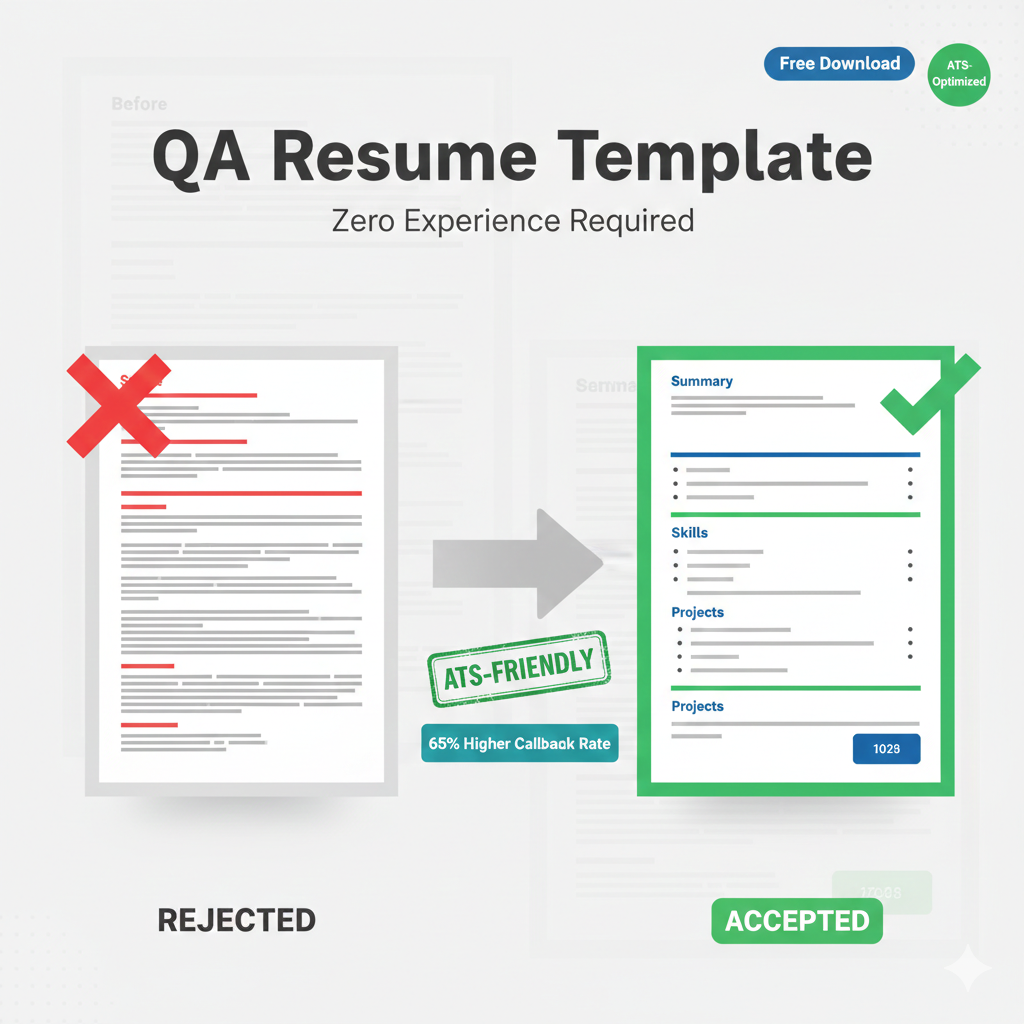
Here's the brutal truth about applying to QA jobs with zero experience: your resume gets 6-8 seconds of attention before it's rejected or moved forward.
That's it. Six seconds.
In those six seconds, hiring managers aren't reading carefully. They're scanning for specific signals: "Does this person understand testing? Can they do this job?"
Without professional QA experience, your resume needs to work twice as hard. The good news? We've worked with career switchers who transformed their resumes and went from 5% callback rates to 35-40% callback rates.
Here's exactly how to write a QA resume that gets you interviews—even with zero professional testing experience.
The Two Resume Killers (And How to Avoid Them)
Before we build your resume, let's address what's getting you rejected.
Killer #1: Generic "Looking for Entry-Level Opportunity" Resumes
What it looks like:
Objective: Seeking an entry-level QA position to utilize my skills

Experience:
- Retail Associate at [Store Name]
  • Provided excellent customer service
  • Handled cash register
  • Restocked inventory
Why it fails:
- No testing-specific skills mentioned
- No evidence you know what QA work involves
- Looks like every other career switcher's resume
The fix: Position yourself as someone who's already doing QA work (via portfolio projects), not someone hoping to learn on the job.
Killer #2: ATS-Unfriendly Formatting
75% of resumes never reach human eyes. They're filtered out by Applicant Tracking Systems (ATS) before anyone reads them.
What kills your ATS score:
- Graphics, images, logos, photos
- Tables and text boxes
- Headers/footers with contact info
- Unusual fonts or colors
- Skills buried in paragraphs instead of clear lists
- Missing keywords from the job description
The fix: Use clean, ATS-friendly formatting with clear section headers and keyword optimization.
The ATS-Friendly QA Resume Structure
Here's the exact structure that works for career switchers:
[Your Name]
[City, Country] | [Phone] | [Email] | [LinkedIn URL] | [GitHub URL]

PROFESSIONAL SUMMARY
[3-4 sentences positioning you as a QA professional]

TECHNICAL SKILLS
[Keyword-rich skills section]

RELEVANT EXPERIENCE / PROJECTS
[Portfolio projects framed as experience]

EDUCATION
[Degree + relevant certifications]

PROFESSIONAL EXPERIENCE
[Previous career, reframed with transferable skills]
Why this order matters:
- Contact info at top (not in header—ATS often can't read headers)
- Summary first sets the narrative: "I'm a QA tester"
- Technical skills second passes ATS keyword filters
- Projects third shows you can do the work
- Education fourth proves foundational knowledge
- Professional experience last demonstrates transferable skills
Let's build each section.
Section 1: Contact Information
What to include:
Jan Kowalski
Warsaw, Poland | +48 123 456 789 | jan.kowalski@email.com
LinkedIn: linkedin.com/in/jankowalski | GitHub: github.com/jkowalski
Pro tips:
- Use your actual city (not full address—privacy + ATS optimization)
- Include country if applying to remote European roles
- LinkedIn and GitHub are mandatory for QA roles
- Use a professional email (firstnamelastname@gmail.com, not coolcoder2000@)
- No photo (common in US/UK, optional in Europe—but takes up space)
Section 2: Professional Summary
This is your elevator pitch. You have 3-4 sentences to position yourself as a QA professional—not a "former retail worker hoping to break into tech."
Bad Example:
Recent career changer seeking an entry-level QA position. Quick learner with strong attention to detail. Eager to contribute to a dynamic team.
Why it fails:
- Focuses on what you want, not what you offer
- Generic phrases ("quick learner," "attention to detail")
- No evidence of QA skills
Good Example:
QA Tester with hands-on experience in manual testing, test case design, and bug documentation through 5+ portfolio projects. Proficient in test design techniques including boundary value analysis and equivalence partitioning. ISTQB Foundation Level certified (2026). Transitioned from [previous field] with strong analytical and communication skills. Seeking junior QA role to apply systematic testing methodologies in Agile environments.
Why it works:
- Opens with "QA Tester" (identity, not aspiration)
- Quantifies experience (5 projects)
- Drops keywords (ISTQB, Agile, test design)
- Acknowledges career transition honestly
- Specific about what you bring
Formula for Career Switchers:
[Job title] with [specific skills] demonstrated through [portfolio/projects/certification]. Proficient in [2-3 key tools/techniques]. [Relevant certification if you have it]. Transitioned from [previous field] with [transferable skills]. Seeking [specific role] to [value you'll add].
Section 3: Technical Skills
This is your ATS keyword goldmine. Hiring managers scan this section to quickly assess if you meet baseline requirements.
How to Structure It:
TECHNICAL SKILLS

Testing Skills: Manual Testing, Test Case Design, Exploratory Testing, Regression Testing, Smoke Testing, Black-Box Testing, Boundary Value Analysis, Equivalence Partitioning

Tools: JIRA, TestRail, Git/GitHub, Chrome DevTools, Postman, Selenium WebDriver (basic)

Programming: Python (basic), SQL (basic)

Methodologies: Agile/Scrum, Software Development Life Cycle (SDLC), Software Testing Life Cycle (STLC)

Documentation: Test Plans, Test Cases, Bug Reports, Requirements Analysis

Certifications: ISTQB Foundation Level (2026)
Pro tips:
Use exact keywords from job descriptions
- If the job says "JIRA," write "JIRA" (not "bug tracking tools")
- If it says "Agile," write "Agile/Scrum" (not "modern workflows")
Be honest about skill level
- Use "basic" for skills you're learning (shows honesty)
- No "basic" for skills you've practiced extensively via projects
Group logically
- Testing Skills (core QA competencies)
- Tools (software you've used)
- Programming (if any—even basic counts)
- Methodologies (frameworks)
- Documentation (types of work products)
- Certifications (if applicable)
Don't lie
- Only list tools you've actually used
- You'll be asked about these in interviews
Section 4: Relevant Experience / Projects
This is where you prove you can do QA work—even without professional experience.
The strategy: Frame your portfolio projects as experience, not "hobby projects."
Bad Example:
Personal Projects:
- Tested some websites for fun
- Wrote test cases for a login page
- Found a few bugs
Why it fails:
- Sounds like casual hobby, not professional work
- No specifics or metrics
- No demonstration of impact
Good Example:
QA TESTING PROJECTS

E-Commerce Checkout Flow Testing | Portfolio Project | Jan 2026
• Designed and executed 25 manual test cases covering happy paths, boundary conditions, and negative scenarios for DemoQA practice site
• Applied equivalence partitioning and boundary value analysis to reduce test cases by 30% while maintaining coverage
• Documented 8 functional bugs and 3 usability issues with detailed reproduction steps and severity assessment
• Tools used: Google Sheets (test cases), JIRA (bug tracking), Chrome DevTools (debugging)
• GitHub: github.com/yourname/qa-portfolio/ecommerce-testing

Login Functionality Bug Analysis | Portfolio Project | Dec 2025
• Conducted exploratory testing on public web application, identifying 5 critical bugs including security vulnerabilities
• Created professional bug reports following industry standards (steps to reproduce, expected vs actual results, screenshots)
• Prioritized bugs by severity and business impact
• Collaborated with developer community via GitHub Issues to validate findings
• GitHub: github.com/yourname/qa-portfolio/login-bugs

Automated Login Tests (Selenium) | Portfolio Project | Jan 2026
• Developed 10 automated test scripts in Python using Selenium WebDriver for login functionality
• Covered valid credentials, invalid credentials, empty fields, and password length validation
• Implemented basic assertions to verify expected outcomes
• Documented setup instructions and execution steps in README
• GitHub: github.com/yourname/qa-portfolio/selenium-tests
Why it works:
✅ Project title first (descriptive, professional)
✅ "Portfolio Project" clarifies it's not employment (honesty)
✅ Bullet points with metrics (25 test cases, 8 bugs, 30% reduction)
✅ Action verbs (Designed, Applied, Documented, Conducted, Created)
✅ Technical terms (equivalence partitioning, regression, assertions)
✅ Tools listed (proves hands-on experience)
✅ GitHub links (evidence you actually did the work)
Formula for Each Project:
[Project Title] | Portfolio Project | [Month Year]
• [Action verb] + [what you did] + [quantifiable outcome]
• [Specific technique/tool used] + [result or learning]
• [Collaboration or process detail]
• Tools used: [list]
• GitHub: [link]
How many projects to list:
- Minimum: 3 projects (shows consistent practice)
- Optimal: 4-5 projects (demonstrates depth without overwhelming)
- Maximum: 6 projects (more than this, focus on quality over quantity)
Section 5: Education
Keep this simple and relevant.
EDUCATION

Bachelor of Arts in [Your Major] | [University Name] | [City, Country] | Graduated [Year]
- Relevant coursework: [if applicable—e.g., Statistics, Logic, Computer Science elective]

CERTIFICATIONS

ISTQB Foundation Level | International Software Testing Qualifications Board | Jan 2026
• Passed with [score if 75%+, otherwise omit]
• Topics: Test design techniques, SDLC/STLC, risk-based testing, test management

[Other relevant certifications: Udemy courses, LinkedIn Learning, etc.]
• Software Testing Fundamentals | Udemy | Dec 2025
• Agile Testing | LinkedIn Learning | Dec 2025
Pro tips:
- List your degree even if it's unrelated (shows you can complete long-term goals)
- ISTQB goes here if you have it (major differentiator)
- Include date for recent certifications (shows current knowledge)
- Online courses count—employers value continuous learning
Section 6: Professional Experience (Previous Career)
Here's the tricky part: how to list your non-QA work history without looking unqualified.
The strategy: Highlight transferable skills that matter for QA work.
Transferable Skills QA Employers Value:
- Attention to detail
- Analytical thinking
- Communication (written + verbal)
- Problem-solving
- Working with stakeholders
- Process improvement
- Documentation
Example: Retail → QA
Bad approach:
Sales Associate | [Store Name] | 2022-2025
• Sold products to customers
• Operated cash register
• Restocked shelves
Good approach:
Sales Associate | [Store Name] | Warsaw, Poland | 2022-2025
• Identified and resolved customer complaints, achieving 95% satisfaction rate through systematic troubleshooting
• Documented inventory discrepancies and collaborated with management to implement process improvements, reducing errors by 20%
• Trained 5 new employees on store procedures, creating clear step-by-step documentation
• Communicated product issues to suppliers with detailed descriptions and visual evidence
Why it works:
- Reframes retail work using QA-relevant language (troubleshooting, documentation, process improvement, defect reporting)
- Includes metrics (95%, 20%, 5 employees)
- Demonstrates skills QA managers care about
Example: Finance → QA
Financial Analyst | [Company Name] | Berlin, Germany | 2020-2025
• Analyzed financial data for accuracy, identifying discrepancies and recommending corrective actions
• Created detailed reports for stakeholders, translating complex data into clear recommendations
• Collaborated with cross-functional teams to validate data integrity across systems
• Documented audit processes and maintained compliance with regulatory standards
Transferable skills highlighted:
- Data accuracy (attention to detail)
- Stakeholder communication
- Cross-functional collaboration
- Documentation and compliance (process adherence)
The Complete Resume Template (Copy-Paste Ready)
Here's the full ATS-friendly template:
JANE KOWALSKA
Warsaw, Poland | +48 123 456 789 | jane.kowalska@email.com
LinkedIn: linkedin.com/in/janekowalska | GitHub: github.com/jkowalska


PROFESSIONAL SUMMARY

QA Tester with hands-on experience in manual testing, test case design, and bug documentation through 5+ portfolio projects testing e-commerce, login systems, and web applications. Proficient in test design techniques including boundary value analysis, equivalence partitioning, and exploratory testing. ISTQB Foundation Level certified (2026). Transitioned from finance with strong analytical, documentation, and stakeholder communication skills. Seeking junior QA role to apply systematic testing methodologies in Agile environments.


TECHNICAL SKILLS

Testing Skills: Manual Testing, Test Case Design, Exploratory Testing, Regression Testing, Smoke Testing, Black-Box Testing, Boundary Value Analysis, Equivalence Partitioning, Risk-Based Testing

Tools & Technologies: JIRA, Git/GitHub, Chrome DevTools, Postman, Selenium WebDriver (basic), TestRail, SQL (basic)

Programming: Python (basic)

Methodologies: Agile/Scrum, Software Development Life Cycle (SDLC), Software Testing Life Cycle (STLC), Test-Driven Development (TDD) concepts

Documentation: Test Plans, Test Cases, Bug Reports, Test Execution Reports, Requirements Analysis

Certifications: ISTQB Foundation Level (2026)


RELEVANT EXPERIENCE / QA PROJECTS

E-Commerce Checkout Testing | Portfolio Project | Jan 2026
• Designed and executed 30 manual test cases for checkout flow covering payment validation, cart functionality, and order confirmation
• Applied boundary value analysis and equivalence partitioning to optimize test coverage
• Identified 10 functional bugs and 4 usability issues, documenting each with detailed reproduction steps, severity level, and screenshots
• Collaborated with open-source community via GitHub to validate findings
• Tools: Google Sheets, JIRA, Chrome DevTools
• GitHub: github.com/jkowalska/qa-portfolio/ecommerce-testing

Login & Authentication Bug Analysis | Portfolio Project | Dec 2025
• Conducted exploratory testing on public web application, discovering 6 bugs including password validation bypass
• Created professional bug reports following industry standard format (environment, steps to reproduce, expected vs actual results)
• Prioritized defects by severity (critical, major, minor) and business impact
• Documented findings in GitHub Issues with visual evidence
• GitHub: github.com/jkowalska/qa-portfolio/login-bugs

Test Automation with Selenium | Portfolio Project | Jan 2026
• Developed 12 automated test scripts in Python using Selenium WebDriver for login, registration, and search functionality
• Implemented assertions to validate expected outcomes (page titles, error messages, successful logins)
• Created reusable test functions to reduce code duplication by 40%
• Documented test execution instructions and dependencies in README
• GitHub: github.com/jkowalska/qa-portfolio/selenium-automation

API Testing with Postman | Portfolio Project | Dec 2025
• Designed and executed 15 API test cases using Postman for RESTful endpoints (GET, POST, PUT, DELETE)
• Validated response status codes, response times (<500ms), and JSON schema structure
• Created Postman collection with pre-request scripts and automated assertions
• Documented API testing approach and findings
• GitHub: github.com/jkowalska/qa-portfolio/api-testing


EDUCATION

Bachelor of Science in Finance | University of Warsaw | Warsaw, Poland | Graduated 2020
• Relevant coursework: Statistics, Data Analysis


CERTIFICATIONS

ISTQB Foundation Level | International Software Testing Qualifications Board | Jan 2026
• Passed with 80% (32/40 correct)
• Topics: Test design techniques, SDLC/STLC, risk-based testing, defect management, test tools

Software Testing Masterclass | Udemy | Dec 2025
• 20-hour course covering manual testing, test case design, bug lifecycle, JIRA

Agile Testing | LinkedIn Learning | Nov 2025
• Testing in Scrum teams, user story testing, continuous integration basics


PROFESSIONAL EXPERIENCE

Financial Analyst | ABC Financial Services | Warsaw, Poland | 2020-2025
• Analyzed financial reports for accuracy, identifying data discrepancies and recommending corrective actions
• Created detailed documentation for audit processes, ensuring compliance with regulatory standards
• Collaborated with cross-functional teams (IT, Operations, Compliance) to validate data integrity
• Communicated complex findings to non-technical stakeholders through clear written reports
• Trained 3 junior analysts on data validation procedures
Before & After: Real Resume Transformation
Let's see how one career switcher improved their resume.
BEFORE (5% callback rate):
JOHN SMITH
john.smith@email.com

Objective:
Seeking entry-level QA position to begin career in software testing.

Education:
Bachelor of Arts in History, 2019

Experience:
Customer Service Representative, 2019-2025
- Helped customers
- Answered phones
- Resolved complaints

Skills:
- Good communication
- Detail-oriented
- Team player
- Quick learner
Problems:
- No QA-specific skills listed
- No evidence of testing knowledge
- Generic buzzwords ("detail-oriented," "team player")
- No portfolio projects
- "Objective" instead of positioning as a tester
AFTER (40% callback rate):
JOHN SMITH
Krakow, Poland | +48 123 456 789 | john.smith@email.com
LinkedIn: linkedin.com/in/johnsmith-qa | GitHub: github.com/jsmith-qa


PROFESSIONAL SUMMARY

QA Tester with hands-on experience in manual testing and test automation through 4 portfolio projects. Proficient in test case design, bug documentation, and exploratory testing. ISTQB Foundation Level certified (2026). Transitioned from customer service with strong communication, problem-solving, and stakeholder management skills. Seeking junior QA role in Agile environment.


TECHNICAL SKILLS

Testing: Manual Testing, Exploratory Testing, Test Case Design, Regression Testing, Smoke Testing, Boundary Value Analysis, Equivalence Partitioning

Tools: JIRA, Git/GitHub, Postman, Chrome DevTools, Selenium (basic)

Methodologies: Agile/Scrum, SDLC, STLC

Documentation: Test Cases, Bug Reports, Test Plans

Certifications: ISTQB Foundation Level (2026)


RELEVANT EXPERIENCE / QA PROJECTS

Web Application Testing | Portfolio Project | Jan 2026
• Designed 25 test cases for e-commerce checkout flow
• Identified 7 bugs with detailed reproduction steps
• Tools: JIRA, Chrome DevTools
• GitHub: github.com/jsmith-qa/portfolio/web-testing

[2 more projects listed similarly]


EDUCATION

Bachelor of Arts in History | Jagiellonian University | 2019
ISTQB Foundation Level | 2026


PROFESSIONAL EXPERIENCE

Customer Service Representative | XYZ Company | 2019-2025
• Resolved customer complaints through systematic troubleshooting, achieving 92% satisfaction rate
• Documented recurring issues and collaborated with product team to implement fixes, reducing complaints by 15%
• Communicated technical issues to IT department with clear problem descriptions
What changed:
✅ Professional summary positions him as "QA Tester"
✅ Technical skills section packed with keywords
✅ Portfolio projects prove he can do the work
✅ Customer service experience reframed with QA-relevant skills
✅ ISTQB certification added credibility
✅ GitHub portfolio demonstrates initiative
Result: Went from 1 callback in 20 applications to 8 callbacks in 20 applications.
ATS Optimization Checklist
Make sure your resume passes Applicant Tracking Systems:
✅ File format: Save as .docx or .pdf (NOT .pages, .odt, or image files)
✅ File name: Use "FirstName_LastName_QA_Resume.pdf" (not "Resume_Final_v3.pdf")
✅ Font: Standard fonts only (Arial, Calibri, Times New Roman, Verdana)
✅ Font size: 10-12pt for body text, 14-16pt for name
✅ No graphics: No logos, images, charts, or text boxes
✅ No headers/footers: Put contact info in the body, not header
✅ No tables: Use simple text formatting
✅ Clear section headers: "PROFESSIONAL SUMMARY," "TECHNICAL SKILLS," etc.
✅ Keywords from job description: Mirror exact terminology
✅ No abbreviations without full term: Write "Quality Assurance (QA)" first time
How to Tailor Your Resume for Each Job
Don't send the same resume to every company. Spend 10 minutes tailoring it:
Step 1: Read the job description carefully
- Highlight required skills and tools
- Note specific terminology (e.g., "regression testing," "JIRA," "Agile")
Step 2: Mirror their language in your Technical Skills section
- If they say "API testing," use "API testing" (not "backend testing")
- If they mention "Postman," add "Postman" to your tools list (if you've used it)
Step 3: Adjust your Professional Summary
- If the job emphasizes Agile, mention "Agile environments" in your summary
- If it's automation-focused, lead with your Selenium project
Step 4: Reorder your projects
- Put the most relevant project first
- If they want automation, lead with your Selenium project
- If they want manual, lead with your comprehensive test case project
Example: Tailoring for "Junior QA Tester - Agile Team, JIRA Required"
Original Summary:
"QA Tester with experience in manual testing and test automation..."
Tailored Summary:
"QA Tester with experience in Agile environments, specializing in manual testing, test case design, and JIRA-based bug tracking..."
Same person, same skills—but now aligned with what this specific employer wants.
Common Mistakes Career Switchers Make
Mistake 1: Apologizing for Lack of Experience
❌ "Although I don't have professional QA experience..."
✅ "QA Tester with hands-on experience through 5 portfolio projects..."
Don't lead with what you lack. Lead with what you have.
Mistake 2: Listing Irrelevant Old Jobs
If you worked as a barista in college, you probably don't need it on your QA resume. Focus on:
- Last 5-10 years of work
- Jobs with transferable skills
- Anything tech-related
Mistake 3: No Metrics or Specifics
❌ "Tested websites and found bugs"
✅ "Designed 30 test cases, identified 8 functional bugs, reduced test execution time by 25%"
Numbers make your accomplishments tangible.
Mistake 4: Skills Section is a Mess
❌ Listing "Microsoft Office, Communication, Problem-Solving, JIRA, Teamwork"
This mixes soft skills (teamwork) with tools (JIRA) and generic skills (Office). Separate them:
- Technical Skills: JIRA, Postman, Git
- Soft Skills: (optional section if you must, but better to demonstrate in experience)
Mistake 5: GitHub Link Goes Nowhere
If you list GitHub, make sure:
- Your profile is complete (name, bio, location)
- Repositories are public
- READMEs explain what each project does
- Code is clean and commented
A broken or empty GitHub link is worse than no link.
What Happens After You Send Your Resume
Understanding the hiring process helps you optimize:
Day 1-3: ATS screening
- Your resume is scanned for keywords
- 60-75% of resumes are filtered out here
- Your job: Pass keyword filters with relevant skills
Day 4-7: Recruiter screen (6-8 seconds)
- Recruiter skims for "Does this person fit?"
- They're looking for: role-specific skills, relevant experience, clear communication
- Your job: Make it scannable—clear headers, bullet points, metrics
Day 8-14: Hiring manager review
- If you pass the recruiter, the QA manager reads more carefully
- They're asking: "Can this person do the work? Will they fit the team?"
- Your job: Portfolio projects prove capability, professional experience shows reliability
Day 15+: Interview invitation
- Only 5-15% of applicants get here
- Your resume got you in the door—now you need to perform in the interview
When You Need More Than Just a Resume
A great resume gets you interviews. But landing the job requires:
- Portfolio projects that hiring managers want to see
- Interview skills to explain your career transition confidently
- Technical knowledge to answer QA questions on the spot
- Job search strategy to target the right companies
This is where mentoring makes the difference.
In our Career Switcher program:
- Month 1-3: Build portfolio projects we help you position on your resume
- Month 3: CV optimization—we review and refine your resume for maximum impact
- Month 5: Active job search coaching—tailor your resume to specific roles, practice explaining your career switch
You don't just get a template. You get personalized feedback on your resume from someone who understands what hiring managers look for.
Ready to build a resume that actually gets callbacks? Apply for our Career Switcher mentoring program →
We're working with 8-10 mentees this cohort. You'll build projects, get your resume reviewed multiple times, and practice interviews—so when you apply, you're truly ready.
Questions about writing your QA resume? Drop them in the comments below. We read and respond to every one.
About TestTactix
We help non-tech professionals transition to QA careers through personalized 1-on-1 mentoring. Our 5-month program includes CV optimization, portfolio project guidance, and active job search support to help you land your first QA role—no CS degree needed.