
Manual Testing vs. Automation: Which Should You Learn First in 2026?
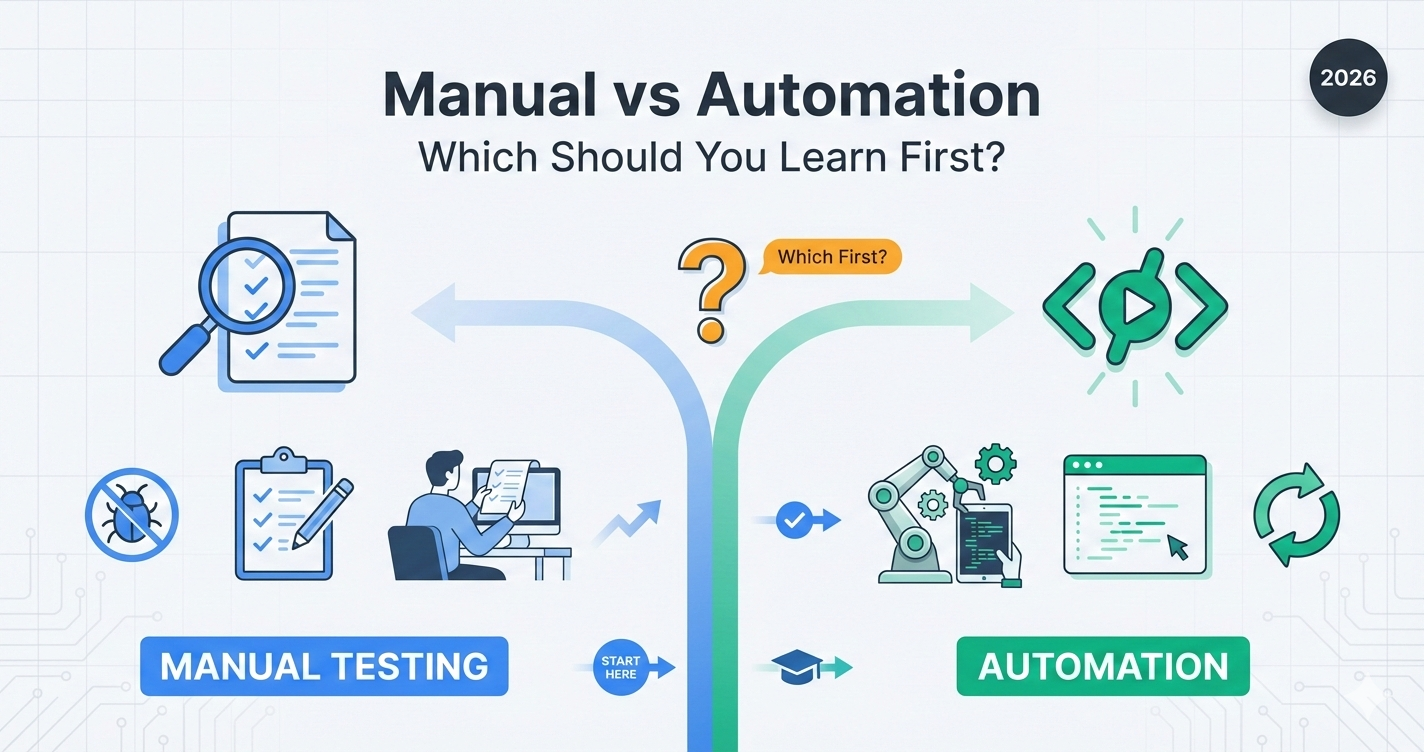
If you're switching careers into QA, you've probably heard conflicting advice:
"Learn automation—manual testing is dead."
"Start with manual—automation without fundamentals is useless."
"Just learn both at the same time!"
Here's what the data actually says: 87% of entry-level QA job postings in Europe require manual testing experience, while only 23% mention automation as a requirement for junior roles.
The automation testing market is growing at 16% annually, but that growth is creating jobs for experienced testers who understand what to automate and why—not for beginners who can copy-paste Selenium scripts without understanding the testing principles behind them.
This isn't about which skill is "better." It's about which path gets you hired faster, builds a stronger foundation, and sets you up for long-term career growth.
Here's the honest breakdown.
The Job Market Reality: What Employers Actually Want
Let's start with the numbers that matter: what are companies hiring for right now?
Entry-Level QA Job Requirements (Poland & Germany, Jan 2026)
We analyzed 150 junior QA job postings across Poland, Germany, and remote-friendly European companies. Here's what they require:
Manual Testing Skills (87% of postings):
- Test case design and execution
- Bug reporting and documentation
- Understanding of SDLC/STLC
- Exploratory testing
- Regression testing
- Tools: JIRA, TestRail, basic Excel/Google Sheets
Automation Skills (23% of postings):
- Basic Selenium or similar framework
- One programming language (Python or Java most common)
- Understanding of CI/CD concepts
- Note: Even these postings list manual testing as a prerequisite
The pattern is clear: Companies expect junior QA engineers to start with manual testing and grow into automation.
Why? Because automation is only valuable when you understand what to test, why it matters, and when automation makes sense. That knowledge comes from manual testing experience.
Manual Testing: Your Foundation (Month 1-3)
Manual testing isn't "clicking around randomly." It's a disciplined approach to understanding software quality.
What Manual Testing Actually Teaches You
1. Critical Thinking
You learn to ask questions automated scripts never will:
- What happens if a user does this in the wrong order?
- How does this feature behave under stress?
- Is this error message helpful to non-technical users?
- Does this violate accessibility standards?
Real example from a mentee:
She was testing a password reset feature. The automation script checked: "Does the reset email arrive?" Pass. Done.
She asked: "What if someone requests 50 password resets in 2 minutes?" She found the system sent all 50 emails, with no rate limiting—a security issue and a potential spam problem.
No automation script would have caught that without someone thinking to test it first.
2. Test Design Techniques
Manual testing teaches you how to design tests:
- Equivalence Partitioning: Grouping similar inputs to reduce test cases
- Boundary Value Analysis: Testing edges (min, max, just above/below limits)
- Decision Tables: Mapping complex business logic
- State Transition Testing: How systems move between states
- Error Guessing: Using experience to predict where bugs hide
These aren't manual-only skills. They're testing skills. When you move to automation, you'll automate tests you designed using these principles.
3. Communication and Documentation
Manual testing forces you to document clearly:
Test Case ID: TC_LOGIN_003
Title: Login fails with invalid password
Priority: High

Steps:
1. Navigate to login page
2. Enter valid email: user@example.com
3. Enter invalid password: WrongPass123
4. Click Login button

Expected Result:
- Login fails
- Error message: "Invalid email or password"
- User remains on login page
- No session created

Actual Result: [Pass/Fail]
This clarity matters. When you find a bug, developers need to reproduce it. Vague reports like "login doesn't work" waste everyone's time.
Good manual testers write reports developers can act on immediately. That skill makes you valuable on any team.
Automation Testing: Your Accelerator (Month 4+)
Automation isn't a replacement for manual testing. It's a force multiplier for tests you've already validated manually.
What Automation Actually Does
Automation excels at:
1. Regression Testing
Every time the codebase changes, you need to verify nothing broke. Automation runs those checks in minutes instead of hours.
Example: An e-commerce site with 50 core user flows. Manual regression: 2-3 days. Automated regression: 30 minutes.
2. Data-Driven Testing
Testing the same feature with 100 different input combinations. Automation runs all 100 overnight. Manual testing would take days.
3. CI/CD Integration
Automated tests run every time code is pushed, catching bugs before they reach production. This is how modern teams ship fast without breaking things.
The Learning Path That Actually Works
Here's the path we recommend based on what we've seen work for career switchers.
Phase 1: Manual Testing Fundamentals (Months 1-3)
What to learn:
- Software Testing Life Cycle (STLC)
- Test case design techniques
- Bug lifecycle and severity/priority
- Exploratory vs. scripted testing
- Tools: JIRA, TestRail, Chrome DevTools
How to practice:
- Test 3-5 public websites or apps
- Document 30-50 test cases
- Write 10-15 professional bug reports
- Build a GitHub portfolio with your work
Time commitment: 10-15 hours/week
Outcome: You can apply for junior manual QA roles and have portfolio proof of your skills.
Realistic timeline to first job: 3-4 months from starting your learning.
Phase 2: Automation Basics (Month 4)
What to learn:
- Programming fundamentals (Python or Java)
- One automation tool (Selenium WebDriver recommended)
- Locators and element identification
- Assertions and test validation
- Basic framework structure
How to practice:
- Automate 5-10 test cases you wrote manually
- Focus on simple, stable tests (login, search, form submission)
- Document your code clearly in GitHub
Time commitment: 12-15 hours/week (more than manual because you're learning to code)
Outcome: You have 1-2 automation projects in your portfolio demonstrating you understand the basics.
Phase 3: Job Readiness (Month 5)
What to focus on:
- ISTQB Foundation certification (optional but helpful)
- CV optimization for manual + basic automation
- Interview preparation (technical + behavioral)
- Active job search and applications
Outcome: You're applying to jobs confidently with:
- Manual testing skills (proven via portfolio)
- Automation fundamentals (1-2 projects)
- Professional documentation (GitHub README, test cases)
- Certification (if pursuing ISTQB)
Common Mistakes to Avoid
Mistake 1: Jumping Straight to Automation
Why it fails: You don't know what to automate or why. Your tests are fragile, break constantly, and don't actually catch bugs.
Example: A career switcher learned Selenium first, automated a login test, and proudly showed us. The test passed even when the login actually failed—because he didn't understand how to write proper assertions.
Three months later, after learning manual testing fundamentals, he rewrote that test properly. He said: "I was automating blindly. I didn't understand what I was testing."
Mistake 2: Thinking Manual Testing is "Easy" or "Low-Skill"
Manual testing done well is hard. Finding edge cases, designing efficient test coverage, and documenting clearly are skills that take practice.
Companies pay manual testers well (€30,000-38,000 entry-level in Europe) because good manual testers prevent expensive bugs from reaching production.
Don't dismiss manual testing as "just clicking buttons." That mindset will show in your work.
Mistake 3: Learning Too Many Tools at Once
"Should I learn Selenium, Cypress, Playwright, Postman, JMeter, and Appium?"
No. Pick one automation tool. Master it. Then expand.
Employers don't need you to know six tools. They need you to understand testing principles and demonstrate competence in one modern tool.
Start with Selenium (highest job demand) or Postman (easier entry point for API testing).
Salary Reality Check: Manual vs. Automation
Let's talk money. Does learning automation immediately increase your salary? Not as much as you'd think—at the entry level.
Entry-Level Salaries (Europe, 2026)
Manual QA Tester (Junior):
- Poland: €18,000-24,000/year (6,000-9,000 PLN gross/month)
- Germany: €38,000-45,000/year
- UK: €35,000-45,000/year
- Western Europe average: €30,000-38,000/year
QA Engineer with Basic Automation (Junior):
- Poland: €20,000-28,000/year (7,000-10,000 PLN gross/month)
- Germany: €42,000-50,000/year
- UK: €38,000-48,000/year
- Western Europe average: €35,000-42,000/year
Salary difference at entry level: 10-15% premium for automation skills.
But here's the key insight: Most "junior automation" roles still require 1-2 years of manual testing experience. You're not bypassing the manual phase—you're adding automation on top of it.
Mid-Level Salaries (2-4 years experience)
This is where automation skills significantly boost salary:
Manual QA Specialist:
- Europe average: €40,000-50,000/year
Automation QA Engineer (SDET):
- Europe average: €50,000-70,000/year
Salary difference at mid-level: 25-40% premium for strong automation skills.
The takeaway: Learn manual first to get hired. Add automation to accelerate your career growth and salary trajectory.
The 70/30 Rule for Modern QA
Here's the industry reality in 2026: even heavily automated teams still use manual testing.
A typical QA team breakdown:
- 70% of tests are automated: Regression, smoke tests, API tests, data validation
- 30% remain manual: Exploratory testing, usability, new feature validation, edge cases
Why?
Because some things are expensive or impossible to automate:
- "Does this feel intuitive to use?"
- "Is this error message confusing?"
- "What if a user does something completely unexpected?"
- "Does this design work for colorblind users?"
These require human judgment.
The best QA engineers know when to automate (repetitive, stable, high-value tests) and when to test manually (exploratory, UX-focused, new features).
You learn that judgment through manual testing experience.
What About AI and the Future of Testing?
You've probably heard: "AI will replace manual testers!"
Here's the nuanced truth:
AI is changing testing, but not eliminating it.
- Self-healing tests: AI can detect when a UI element changes and auto-update locators
- Test generation: AI can suggest test cases based on requirements
- Bug detection: AI can flag anomalies in application behavior
But AI still needs humans who understand:
- What quality actually means for this specific product
- How to design test strategies
- How to interpret AI-generated results
- How to make judgment calls on severity and priority
AI will eliminate low-value manual tasks (clicking through the same regression tests 100 times). It won't eliminate the need for testers who think critically.
Career advice: Learn manual testing fundamentals so you understand what AI is doing. Then learn to work with AI tools to amplify your effectiveness.
The future isn't "manual vs. automation vs. AI." It's testers who use all three strategically.
Real Career Switcher Story: Why Manual First Worked
One of our mentees came from retail management. She asked us: "Should I just learn Selenium to get hired faster?"
We said: "Start with manual. Trust the process."
Month 1-2: She learned test case design, wrote 40 test cases for an e-commerce site, found 8 real bugs, documented everything professionally.
Month 3: She applied to 15 junior QA roles. Got 5 interviews. Three companies specifically mentioned her portfolio in the interview request.
Month 4: She started her first QA job as a manual tester (€22,000/year, Poland). The company paid for her ISTQB cert and gave her time to learn automation on the job.
Month 10: She's now writing Selenium tests at work, earning €26,000/year after a promotion, and her company is sponsoring further automation training.
Her reflection: "If I'd started with automation, I would've been lost. Manual testing taught me how to think like a tester. Automation is just making my tests run faster now."
That's the path that works.
The Verdict: Manual First, Then Automation
For career switchers in 2026, the answer is clear:
✅ Start with manual testing (Months 1-3)
- Faster to learn
- Easier to get your first job
- Builds the foundation you'll need forever
- 87% of entry-level jobs require it
✅ Add automation basics (Month 4)
- Increases your job prospects
- Sets you up for salary growth
- Demonstrates you can learn technical skills
- 23% of entry-level jobs require it (but with manual foundation)
✅ Grow into automation specialist (Year 2+)
- Once you have 1-2 years of manual experience
- When you understand testing strategy deeply
- This is when automation significantly boosts salary
The wrong path:
❌ Jump straight to automation without manual foundation
❌ Think manual testing is "beneath you"
❌ Try to learn both simultaneously as a beginner
Your 5-Month Learning Roadmap
Here's the exact timeline we use with career switchers:
Month 1: Manual Testing Foundations
- Week 1-2: STLC, test case design, bug reporting basics
- Week 3-4: Practice projects—test 2 public websites, write test cases
Month 2: Manual Testing Practice
- Week 1-2: Test design techniques (equivalence, boundary, decision tables)
- Week 3-4: Build portfolio—document 30 test cases, 10 bug reports on GitHub
Month 3: Tools & Processes
- Week 1-2: Learn JIRA, TestRail, Agile/Scrum basics
- Week 3-4: ISTQB Foundation study (optional), portfolio polish
Month 4: Automation Introduction
- Week 1-2: Python/Java basics, Selenium setup
- Week 3-4: Write 5-10 simple automated tests, add to portfolio
Month 5: Job Readiness
- Week 1-2: CV optimization, LinkedIn profile setup
- Week 3-4: Active job search, mock interviews, applications
Time commitment: 10-15 hours/week (manageable while working full-time)
Outcome at Month 5: You're job-ready with:
- Strong manual testing skills
- Basic automation knowledge
- Professional portfolio on GitHub
- ISTQB certification (if pursued)
Realistic first job timeline: 3-6 months from starting this path.
Tools You'll Actually Use
Manual Testing Phase (Free)
- Documentation: Google Docs, Excel, Notion
- Bug tracking: JIRA (free tier), GitHub Issues
- Browsers: Chrome DevTools, Firefox Developer Tools
- Screenshots: Lightshot, Snipping Tool
- Mind mapping: XMind (for test planning)
Automation Phase (Free)
- Programming: Python or Java (both free)
- Automation tool: Selenium WebDriver (free, open-source)
- IDE: VS Code (free) or PyCharm Community (free)
- Version control: Git + GitHub (free)
- API testing: Postman (free tier)
Total cost to learn both: €0
(Optional: ISTQB exam €200, courses €100-200 if you prefer structured learning)
When Does Automation Become Your Focus?
You'll know you're ready to specialize in automation when:
✅ You've worked as a manual tester for 1-2 years
✅ You understand testing strategy deeply (what to test, why, when)
✅ You're comfortable with one programming language
✅ You see inefficiencies in manual processes and want to solve them
✅ Your team or job market is actively seeking automation skills
At that point, invest heavily in:
- Test frameworks (Page Object Model, Data-Driven, BDD)
- CI/CD integration (Jenkins, GitHub Actions, GitLab CI)
- Advanced tools (Playwright, Cypress for modern web apps)
- API and performance testing (Postman, JMeter, K6)
This is when "Automation QA Engineer" or "SDET" (Software Development Engineer in Test) roles become realistic targets—with salaries in the €50,000-70,000 range in Europe.
The Mentoring Advantage: Learn With Guidance
You can absolutely learn manual and automation testing on your own. Thousands of people do it.
But here's what self-learners struggle with:
- "Am I learning the right things?" (Spending months on outdated tools)
- "Is my portfolio good enough?" (No feedback until you start getting rejected)
- "How do I explain this in interviews?" (Technical skills don't automatically translate to job offers)
This is where mentoring makes the difference.
With our Career Switcher mentoring program:
- Month 1-3: Your manual test cases get reviewed by someone who's hired QA engineers
- Month 4: Your automation code gets feedback—learn what actually works vs. what's textbook theory
- Month 5: Active job search coaching—CV tailored to specific jobs, mock interviews, salary negotiation
You're not just learning skills. You're learning what employers actually care about.
Ready to learn the right way, in the right order? Apply for our Career Switcher mentoring program →
We're working with 8-10 mentees this cohort. Week 1-3: Manual fundamentals. Month 4: Automation introduction. Month 5: Land your first job.
Questions about manual vs. automation testing? Drop them in the comments below. We read and respond to every one.
About TestTactix
We help non-tech professionals transition to QA careers through personalized 1-on-1 mentoring. Our 5-month program teaches manual testing first (Months 1-3), adds automation basics (Month 4), and includes active job search support (Month 5)—no CS degree needed.